For same-city caregivers managing aging parents while running their own lives — on caregiver resentment, body cost, and what sustainable presence actually requires.
You Don’t Dread Your Parent. You Dread What You Become When You Get There.
You know the drive.
You’ve taken it 40 times in the last year. And somewhere around the halfway point, somewhere between the highway merge and the first traffic light on their street, you notice it arriving.
The tightening. The mental rehearsal. The quiet steeling of yourself for today’s version of it.
Maybe it’s the questions that loop. Maybe it’s the criticism wrapped in concern. Maybe it’s the way your siblings have strong opinions from a comfortable distance, while you are the one who shows up.
You park. You take a breath. You walk in already performing patience you don’t fully have.
Two hours later, you drive home and sit in the driveway for a few minutes before going inside.
Not because anything terrible happened. Just because the version of you that went in there isn’t fully back yet.
The Resentment That Has No Respectable Name
Resentment in caregiving is treated as shameful. Something to manage, suppress, or pray away.
But in my work with local caregivers, the ones who are physically close, repeatedly present, and silently carrying more than anyone around them knows, resentment is almost never what it looks like. It is rarely about not loving enough. It is almost always a precise signal.
Resentment isn’t a failure of love. It’s what happens when giving has consistently outpaced receiving
— and no one, including you, has been keeping track.
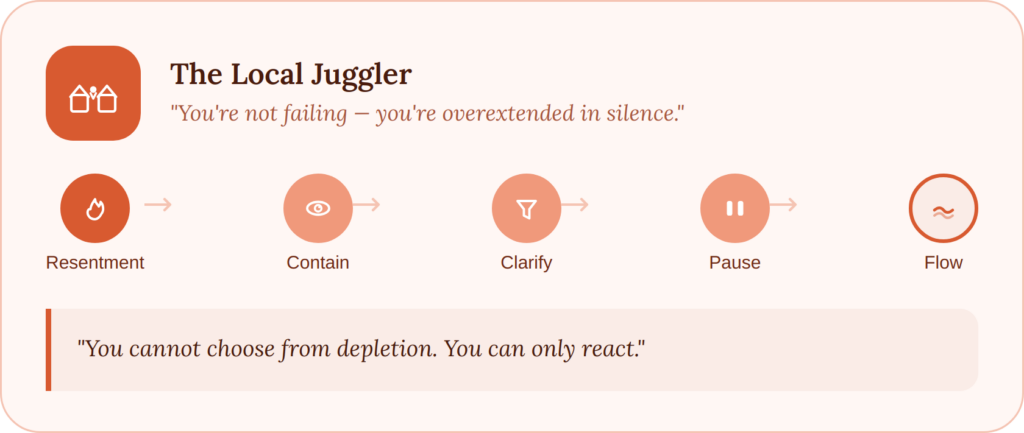
The signal is worth reading. Because underneath resentment in most local caregivers is a state I call ‘Carrying Everyone’ – the sustained internal posture of: they just need support, I don’t mind doing more, I can hold this for them.
This state is not a weakness. It is, in many ways, a sophisticated form of love. But it has a structural flaw: it makes you porous. Other people’s needs override your plans. Interruptions are constant. Your personal time quietly disappears, not through one dramatic theft, but through a thousand small ones, so gradual you don’t notice until you try to think of the last thing you did that was purely yours.
When ‘Carrying Everyone’ runs long enough without relief, it collapses into something harder: irritability, resentment, that particular kind of flatness that arrives when you’ve been available for everyone and no one has thought to ask if you’re okay.
What It Does to Your Body
Kavitha manages a team of eight at a financial services firm in Mississauga. She also drives to her parents’ home every Tuesday and Friday, handles their medical appointments, fields calls from her brother in London who ‘stays updated,’ and comes home to cook dinner for her own family.
She describes her health over the last 18 months as: ‘I keep getting sick.’ Low-grade colds that won’t fully clear. Headaches that start on Sunday evenings. A chest tightness she has mentioned to her doctor twice and has been told is ‘probably stress.’
It is stress. But it’s a specific kind.
Research: Dementia caregiving research links chronic caregiving stress to higher rates of hypertension, cardiovascular disease, metabolic syndrome, diabetes, and frailty —
as well as impaired immune responses to vaccines and slower wound healing.
The pathway is chronic inflammation driven by sustained cortisol dysregulation. Roth et al., Gerontologist Review, 2024
Kavitha doesn’t have a parent with dementia. But the physiological pathway is the same: sustained overload, insufficient recovery, a nervous system that has been running its stress response for so long it has started to cost the body.
She is not imagining the headaches. She is not being dramatic about the fatigue. Her body is giving her the same information her emotions are. It’s just that the body is harder to ignore, and also the last thing she has time to listen to.
What It Does to Your Work and Your Marriage
The fraying doesn’t happen at the caregiving site. It happens everywhere else.
Kavitha’s husband gets the depleted version. Her children get the short fuse. Her colleagues get someone who is technically present but arriving with a smaller reservoir than they used to. She describes coming home from a caregiving visit and feeling like she needs another full day to recover before she can be a person again.
The work research on this is striking.
Research: A large meta-analysis found caregivers experience roughly 32% presenteeism — meaning nearly a third of their on-the-job time is functionally lost due to caregiving-related cognitive and emotional load.
The same research found 44% overall work productivity loss when absenteeism and presenteeism are combined.
Absenteeism and presenteeism among caregivers: meta-analysis, Social Science & Medicine, 2024
Nearly a third of the workday is quietly spent somewhere else.
And at home? A 2021 longitudinal study found that caregiver burden consistently predicted increased work-family and family-work conflict over time, not just immediately, but two years later. The strain was still present, still measurable, still damaging relationships long after the high-pressure period.
The people Kavitha loves most are receiving the residue of a caregiving load they can’t fully see. That is not fair to them. And it is not fair to her.
Why Caregiver Boundary Advice Doesn’t Hold – And What Actually Works
The standard response to this is a list: set limits, ask for help, schedule self-care, and have the conversation with your siblings.
These are not wrong. But they are installed on top of an internal architecture that hasn’t changed. And that architecture – the belief that you have to keep going, the guilt that overrides the limit the moment someone looks disappointed, the identity that has become so fused with reliability that stepping back feels like personal failure – that keeps pulling you back into depletion even when you intellectually know better.
Real choice – the kind that holds under pressure – requires a different kind of work. Not a boundary script. A shift in the internal state.
In the energy framework I use, the movement is from ‘Carrying Everyone’ toward ‘Stepping Back’ – a state where you can pause, where options appear, where you begin choosing instead of reacting. Time slows enough to think. Priorities surface. And from there, something becomes available that hasn’t been for a long time: ‘Steady.’ The state where you can care without absorbing, where presence is chosen rather than compelled.
You cannot choose from depletion. You can only react. Choice requires a different internal state — and that state is learnable.
When Kavitha moves into that state – through the structured work of See Clearly, Create choice, and Recognize yourself – the caregiving doesn’t look dramatically different from the outside. But the Tuesday drives no longer require recovery. The visit doesn’t cost the evening. She starts to recognize herself again in the middle of what used to hollow her out.
For Caregiver Resentment Coaching —Book a 30-minute Discovery Call.
We will name what’s actually driving the depletion — and figure out together whether this is the right next step.
Private. Grounded. No performance required.