Live-In Caregiver Support: Finding Internal Space When External Space Doesn’t Exist
It happened slowly. That’s the thing no one warns you about.
First, the guest bedroom became their room. Then the routines were reorganized around their schedule. Then the sounds you learned to listen for: the shuffle of feet at 3 a.m., the rhythm of breathing you’ve become so attuned to that you wake when it changes.
Somewhere in there, the house stopped being yours.
And somewhere after that, you stopped being fully yours, either.
You are still here. Still functioning. Still, the person people call when something needs handling. But there is a specific kind of numbness that has arrived, not dramatic, not breakdown, just a slow dimming of the particular aliveness that used to be there.
You went to make tea yesterday morning and stood in the kitchen for a moment, not remembering what you liked.
That is the moment worth paying attention to.
Why This Isn’t Just Burnout for Live-in Caregivers
Burnout is what happens when you run too hard and need rest. The prescription is time away. A break. Recovery.
What happens to live-in caregivers is different. It is slower. More complete. And a break (the rare ones you get) often doesn’t restore you the way it should. Because the problem isn’t effort. It’s that the role has absorbed the space where you used to exist.
In the energy framework I use with clients, the dominant state for most live-in caregivers is ‘Carrying Everyone’: trying to keep people okay, maintaining the household’s emotional equilibrium, and staying available for whatever is needed next. This is a real and valuable form of care. But when it becomes the only state – when access to everything above it is blocked – it becomes a container with no exit.
Time becomes porous. Your needs are perpetually deferred. And the inner world -opinions, preferences, humor, the particular texture of who you are – slowly contracts until it fits into whatever space the role hasn’t yet claimed.
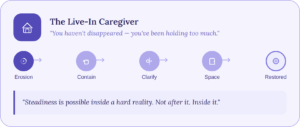
You haven’t disappeared. You’ve been holding too much. And there is a very real difference between those two things.
What It Does to the Body
Meera is a 47-year-old accountant in the GTA. Her mother moved in three years ago after her father died. She thought it would be six months of adjustment. It has been three years of never being fully off.
She describes her physical health over this period as: ‘I don’t bounce back the way I used to.’ A cold last winter that turned into bronchitis. Headaches that live behind her right eye. Sleep that doesn’t restore, eight hours that feel like five because even in sleep, the system doesn’t fully disengage.
She told her doctor she was tired. He suggested she was perhaps ‘doing too much.’
She is doing too much. But the mechanism is more specific than that.
Research now links chronic caregiver stress to immune dysregulation, weakened vaccine responses, slower wound healing, cardiovascular disease, metabolic syndrome,
and measurable acceleration of biological aging — including telomere shortening in key immune cells. Understanding Health Effects of Caregiving Stress, Ageing Research Reviews, 2023
The body under sustained readiness doesn’t rest even when it sleeps. The HPA axis – the system that governs cortisol and the stress response – remains partially activated. Over months and years, this produces the slow degradation Meera is experiencing: not dramatic illness, just a consistent dimming of physical resilience.
Her body is telling her something, and her mind has gotten very good at overriding
More recent research adds an important distinction: it is not caregiving itself that accelerates aging; it is high-strain, unsupported caregiving without adequate recovery. Caregivers with strong support systems show measurably better health outcomes. The biology confirms what experience already knows: containment is the cost, not care. As a Functional Medicine Health Coach, I can attest to this from my personal experience and health journey.
What It Does to the Other Relationships
The invisible cost of live-in caregiving is what it removes from everywhere else.
Meera’s husband, Rohit, describes the last two years as ‘living with someone who is always slightly elsewhere.’ He doesn’t say this critically. He says it sadly. He misses her.
She misses herself, too. She just hasn’t had time to sit with that long enough to fully feel it.
Her friends have mostly stopped texting. Not out of cruelty. They just stopped receiving enough back to keep the thread going. The friendships that took years to build have thinned to occasional check-ins.
At work, she is functional. But she describes her capacity for creative problem-solving, once her strength, as ‘gone somewhere.’ She is executing. She is not thinking.
Research: A 2021 longitudinal study of over 1,000 caregivers found that strain-based work-family conflict — the emotional and cognitive spillover from caregiving into professional life
— was a consistent predictor of both anxiety and depression across two years. The effect was durable, not temporary. Barker et al., Frontiers in Psychology, 2021
All of this, the thinned friendships, the absent quality of presence at home, the contracted professional self, is the relational cost of identity erosion. It isn’t dramatic. It quietly reorganizes the entire landscape of a life around caregiving until the person at the center has become a function rather than a presence.
What Choice Looks Like When You Cannot Leave
The standard advice for live-in caregivers centers on external space: take time away, establish respite, carve out hours. And where possible, this is worth pursuing.
But most live-in caregivers arrive at that advice already knowing it is partly inaccessible. The external space doesn’t exist in the structure of their days. Which makes the advice feel like one more thing to fail at.
What I work on with live-in caregivers is different. It is not external space. It is internal space, and the two are related but not the same thing.
Internal space is the capacity to be in the same house, in the same situation, and still have access to yourself. To your own thoughts, your own emotional experience, your own preferences and responses. The parts of you that exist independently of what is being asked of you right now.
You cannot self-care your way out of constant readiness. You need a different kind of permission — to disengage internally, even when the external situation hasn’t changed.
This is not about willpower. It is not about being less loving. It is about building access to the internal states – Stepping Back, Steady, eventually Clear – that make it possible to be in the same house without being consumed by it.
When those states become available, something shifts. Not the situation. The relationship to it. Meera’s mother is still there. The care still happens. But Meera is there too, now, present in a way that has room in it for her own existence.
She made tea last week and remembered that she likes it slightly sweet. It sounds small. It is not small.
live-in caregiver support —Book a 30-minute Discovery Call.
We will name what your system has been carrying, not to fix you, but to find the way back to you.
Private. Grounded. No performance required.