Caregiver resentment isn’t a sign that something is wrong with you. It’s a signal that something has been wrong with the arrangement for a long time. This post is about what resentment actually means for local caregivers, and what becomes possible when you understand it clearly.

Her mother had a hip replacement.
Recovery was supposed to be six weeks.
It became six months.
She reorganised her work schedule around the visits. Managed her mother’s medications, moods, and fear of being alone. Cooked the meals her mother would actually eat. Ran her own home at the same time. Showed up for her own kids at the same time.
She didn’t complain. She adjusted.
Until her body made the decision for her.
She started cancelling last minute. Going quiet. Not picking up the phone.
And then her mother said it:
“You’re never there when I need you.”
She didn’t say anything back. She went home and didn’t tell anyone what had happened. Not her partner. Not her sister. Not her therapist who she saw on Tuesday afternoons.
What she felt wasn’t sadness. It was a cold, hardening something she didn’t have a name for.
She had given everything her mother asked for. Her mother had said it wasn’t enough. And the part that frightened her most was that somewhere underneath the shock, she agreed.
Not with her mother. With the resentment.
If you’re caring for an aging parent in the same city, this is a particular kind of exhaustion. Not the guilt of distance. The opposite: the exhaustion of proximity. Of being close enough to be called on, but separate enough that the calls never stop.
Close enough that saying no feels cruel. Far enough that every visit costs you half a day.
And the resentment that builds in that gap isn’t dramatic. It doesn’t arrive in one moment. It accumulates in the small things. In the Tuesday visit that ran long when you had a deadline. In the Sunday lunch that was ‘just a few hours’ and wasn’t. In the requests that multiplied as you proved yourself capable of meeting them.
According to the AARP and National Alliance for Caregiving 2025 report, 63 million Americans are now family caregivers, and 39% of them report high emotional stress. Those numbers don’t distinguish between the ones who live an hour away and the ones who live ten minutes away. The internal cost of proximity is rarely counted.
When did you last visit your parent and feel genuinely glad you went?
The resentment is real. And it is not a character flaw.
A 2025 survey by A Place for Mom found that 78% of caregivers report experiencing burnout, with more than half describing it as a weekly or daily occurrence. That figure captures the accumulation: not one hard day, but the steady erosion of a life that was supposed to also be yours.
Resentment is the body’s honest accounting. Everything you absorbed without naming it. Everything you gave without acknowledging the cost.
Here is what I have come to understand about resentment in caregivers who are doing everything right.
It is not a sign that you love your parent less than you thought.
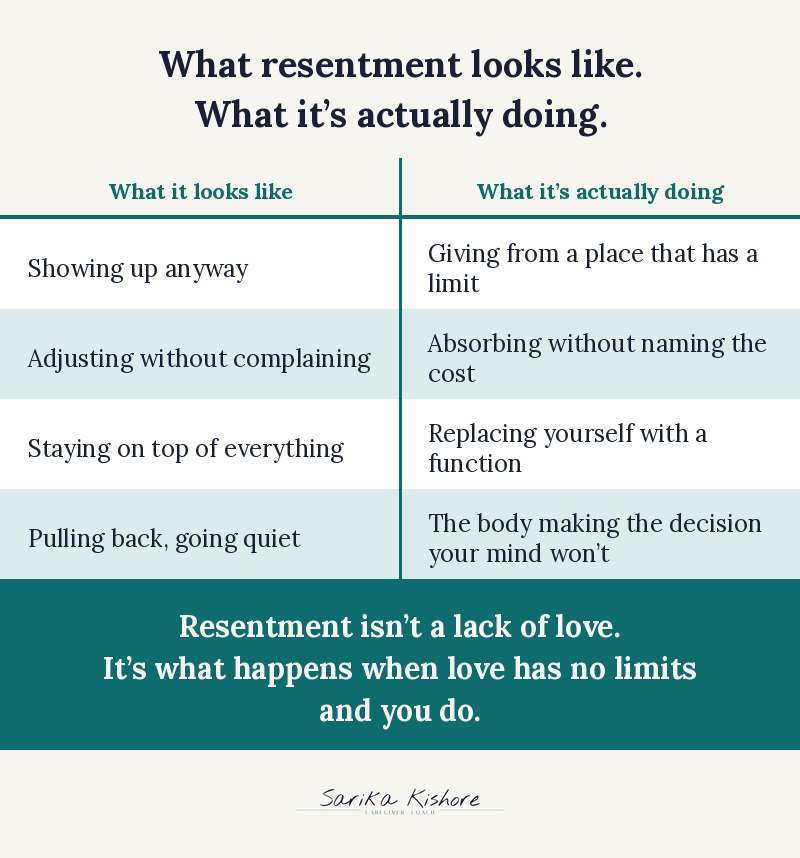
It is a sign that you have been giving from a place that had a limit, without ever naming that limit, for longer than was sustainable.
When you reorganise your schedule, cancel your plans, answer the 9pm call, show up to the appointment that no one else could do, you are not doing those things because you have infinite capacity. You are doing them because the alternative—watching it fall apart when you could have prevented it—feels unsurvivable.
But the body knows what the mind agrees to override.
Resentment is the body’s honest accounting. Everything you absorbed without naming it. Every need you set aside without acknowledging it. Every time you said ‘I’m fine’ when you weren’t, because saying so would have created more work than it resolved.
How long have you been answering that question honestly?
What makes the local caregiver’s situation specific is the visibility problem.
When you are far away, your absence is obvious. When you are in the same city, your presence is assumed. You are the one who can go. So you go. And the more you go, the more you are the one who goes. Until the role settles on you so completely that no one, including you, can remember how it got decided.
The National Family Caregivers Association found that 76% of family caregivers don’t receive consistent help from other family members. And according to the AARP 2025 report, sole caregivers spend double the hours per week of those who share the responsibility. The role doesn’t just settle on one person. It doubles there.
And inside that role, something starts to disappear.
It isn’t your love for your parent. The love stays.
What disappears is the part of you that exists outside of this role. The plans you had. The life you were running. The person you were before you became the one who handles this.
She hadn’t stopped being the person who cared. She had stopped being a person.
This is what resentment is pointing at. Not your parent. Not even the caregiving. The specific loss: the slow replacement of a self by a function.
Researchers have been studying this since at least 2009, when caregiver identity theory first proposed that the central question isn’t how to manage the tasks, but how to reconcile who you were before with who you have become. As NPR reported in 2025, this framing is now widely accepted among psychologists and social workers who study caregiving. And yet most caregivers are never asked that question.
And here is the part that most approaches don’t reach: you cannot boundary your way out of this.
Setting limits is part of the answer. But it isn’t the starting point. Because if the identity that formed around this role is still intact, every limit you set will feel like failure. Like you are not the person you believed yourself to be.
The starting point is seeing clearly what happened. How the role formed. When you stopped being a person with a life and became a function in someone else’s. What it has cost you, not just in time or energy, but in the quieter losses that no one asked about.
What was the last thing you gave up for caregiving that no one knew about?
That is the first phase of the work I do with clients, which I call See Clearly.
Not a plan. Not a list of things to do differently.
A clear-eyed look at the pattern underneath: why you became the one who handles it, what identity got built around that role, and what it has been costing you to maintain it without looking at it.
Resentment isn’t a lack of love.
It’s what happens when love has no limits and you do.
For caregivers in the same city as their parent, the relief that comes from seeing this clearly often arrives as something unexpected.
Not permission to stop caring. Not a limit set. Something quieter.
The recognition that what you have been calling resentment was never about your parent. It was always about you. About the parts of yourself that have been waiting, quietly, for someone to notice they were missing.
From there, the work shifts. Creating choice where you previously only had obligation. Understanding how to show up as a person, not just a function. And examining the belief that your worth is measured by how much you give, with the honest question: where did that come from, and does it still serve you?
Being capable isn’t consent to be used up.
What becomes possible on the other side isn’t detachment. It’s a cleaner form of presence. You can visit and actually be there, not performing care while bracing internally. You can say no to the Sunday lunch without three days of guilt. You can love your parent without disappearing into the role.
The emotional support that adult children experiencing caregiver resentment actually need doesn’t begin with limit-setting. It begins with being seen inside the specific loss they’re carrying: the self that got replaced by a function, quietly, over time.
That’s what this work is for.
I work with local caregivers and busy professionals who are starting to feel the internal cost of how much they have been holding.
If this is the pattern you’re living—showing up, giving everything, and feeling the resentment rise anyway—a 30-minute conversation might be the right next step.
Not a sales call. Not a strategy session.
Just an honest conversation about what this has been costing you and whether this work is the right fit.
Private. Grounded. No pressure.
Frequently Asked Questions
Why do I feel resentment toward my aging parent?
Resentment in caregivers almost always points to the same thing: giving from a place that had a limit, without ever naming that limit, for longer than was sustainable. It isn’t a sign that you love your parent less than you thought. It’s an accurate signal that something in the arrangement has consistently taken more than you could give. Most caregivers who feel resentment haven’t stopped caring. They have stopped having room for themselves. The resentment is pointing at that loss, not at the person who triggered it.
Is it normal to feel resentment when caring for an aging parent?
Yes, and it is far more common than people admit. A 2025 survey found that 78% of caregivers report experiencing burnout, and most don’t say the harder word: resentment. The admission feels like a failure of character, or of love. But resentment is a signal, not a verdict. It tells you that something has been running at a cost that wasn’t acknowledged. In most cases it is not about the parent. It is about the role, how it formed, what it replaced, and what has been quietly disappearing inside it.
How do I stop feeling resentful toward my parent without feeling guilty?
The most effective starting point isn’t a new strategy or a limit you set. It’s understanding what the resentment is actually pointing at. When you see clearly how the role formed, what it cost you, and where the identity that formed around it came from, the resentment tends to shift on its own. Not because the situation changed, but because your relationship to it did. Setting limits from that place of clarity works differently than setting them from a place of depletion.
What is the difference between caregiving limits and cruelty?
Cruelty is indifference to someone’s genuine need. Setting a limit is recognising that you cannot sustainably meet every need without cost to yourself, and that the cost, sustained long enough, leaves both of you worse off. Most caregivers who resist setting limits are operating from the belief that their worth is tied to how much they give. Examining that belief—with curiosity rather than judgment—is usually what makes the difference between limits that hold and limits that collapse under guilt.
Can coaching help with caregiver resentment?
Yes, and often more directly than therapy or self-help approaches. Coaching doesn’t treat resentment as a symptom to manage. It treats it as information: a clear signal that something specific has been running at cost. The work starts with understanding what that is, moves to creating genuine choice in how you respond, and addresses the identity that formed around the role. Most clients describe a shift in the very first session. Not a resolution of the situation, but a change in how they are experiencing it.
Key Takeaways
Caregiver resentment is not a sign of insufficient love. It is a signal that giving has consistently outpaced receiving, and that the internal system has been keeping score without being asked. Most caregivers who feel it have not stopped caring. They have stopped having room for themselves.
For local caregivers, the visibility problem is specific. When you are in the same city, your presence is assumed. The role settles on you by default, and the more capable you prove yourself, the more it consolidates. Research shows that sole caregivers do double the hours of those who share the responsibility.
Setting limits without addressing the identity that formed around the role is often only partially effective. If your worth feels tied to how much you give, every limit will feel like failure. The starting point is seeing clearly how that identity formed, not managing the symptoms it produces.
The emotional support adult children experiencing caregiver resentment actually need doesn’t begin with limit-setting advice. It begins with being seen inside the specific loss they are carrying: the person they were before they became the one who handles this.
Resentment isn’t a lack of love. It’s what happens when love has no limits and you do. Recognising that distinction—clearly and without judgment—is often the first thing that changes the experience from inside.
You might also find this useful
- Same City Caregiver Resentment: What It Actually Means
- When Competence Becomes Your Only Option
- Caregiver Coaching for Busy Professionals