For the eldest child and default leaders managing aging-parent care — on obligation-based identity, the invisible load, and what leading from choice actually requires
Your Competence Became Your Assignment. That’s Not the Same as a Choice.
You didn’t raise your hand for this.
There was no meeting.
No conversation where the family sat down and said: we’ve reviewed everyone’s capacity, weighed the options, and decided you’re the one who will coordinate the medical appointments, interpret the doctor’s language for your parents, manage the finances, referee the sibling conflicts, and hold the emotional weight of all of it.
While maintaining your own career, your own family, and the appearance of someone who has everything under control.
It just happened. You were capable. You showed up. And capable people who show up reliably become, over time, the person everyone stops thinking of replacing.
So here you are. The default. The one who handles it.
And lately, something inside you has started cracking.
What Default Leader Caregiver Burnout Actually Looks Like Internally
Amit is a 42-year-old engineer in Calgary. Eldest of three siblings. His parents are in their 70s, both in India, both with health conditions that require management from here.
He describes his days as: ‘I am always either actively doing something for them or preparing to do something for them.’
On the surface, this looks like love and competence. And it is both of those things.
But it is also what I call the ‘Handling It’ state. The internal posture of constant management, control, and readiness that has been running for so long has become invisible. Amit has forgotten what it feels like to think about his own life without the caregiving infrastructure sitting in the background of every thought.
When ‘Handling It’ goes on long enough without support, it doesn’t announce its collapse. It seeps. Through the sharpness that arrives when someone makes a simple request, he doesn’t have the bandwidth for. Through the difficulty delegating, not because he doesn’t trust people, but because his self-concept has become so organized around competence that relinquishing control feels like losing something essential. Through the creeping awareness that his wife is beginning to describe their relationship as ‘transactional.’
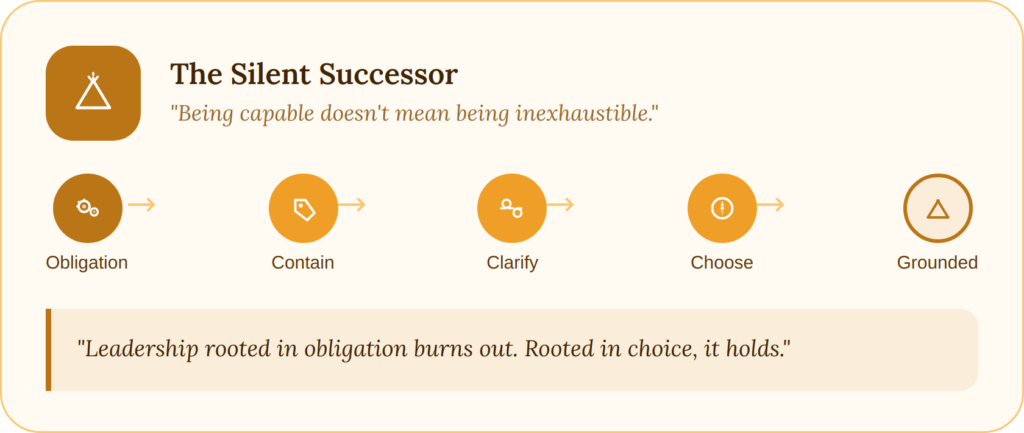
Being capable doesn’t mean being inexhaustible. But the people around you learned early that you were capable — and they stopped checking.
What It Does to the Body, Including Things You’ve Dismissed
Amit has a persistent tension headache that has been present for approximately 14 months. He has attributed it to screen time, posture, and not enough water. He has not connected it to the sustained cognitive load of managing a caregiving infrastructure across time zones while running a full-time technical career.
He should.
Research: A comprehensive review of caregiving and health found links to hypertension, cardiovascular disease, metabolic syndrome, diabetes, weakened vaccine response,
and slower wound healing. Inflammatory markers are significantly elevated in caregivers compared with non-caregivers. The mechanism is sustained HPA axis activation —
the same system that produces the feeling of being ‘always on.’ Understanding Health Effects of Caregiving Stress, Gerontologist, 2024
The immune system under sustained load becomes less efficient. Injuries take longer to heal. The body’s capacity to regulate its own inflammation decreases. This is not psychosomatic. It is the measurable physiological cost of a nervous system that has been running a controlled stress response for too long, in too many domains, without adequate recovery.
Amit also sleeps poorly. He wakes at 4 a.m. with a full mental to-do list. He has accepted this as his personality. It is not his personality. It is a chronic activation looking for an exit.
Research: Research consistently links insufficient sleep to measurable work performance decline, with employees experiencing even low-level sleep disruption
showing significantly reduced productivity. Caregivers are disproportionately affected by the cognitive spillover from monitoring and planning that continues through sleep.
Uehli et al., Kansas State Employee Wellness Program, PMC
What It Is Doing to Your Professional and Personal Life
Amit was recently passed over for a promotion he was expected to receive. His manager’s feedback was: ‘You’ve seemed less present this year.’
He was less present. Not because he cared less. Because the bandwidth required to manage his parents’ situation had quietly consumed the bandwidth he used to bring to his most generative professional thinking.
At home, his wife, Nisha, has started making decisions about their children’s schooling, social calendar, and finances without consulting him. Not out of exclusion. Out of protection. She stopped bringing things to him because he was always already carrying something.
He noticed. He hasn’t had the energy to address it.
Research: The National Study of Caregiving found nearly 1 in 4 employed caregivers reported caregiving-related productivity loss in a single month.
Among those most affected, the costs extend beyond missed time — into relationship quality, professional trajectory, and identity coherence. Fakeye et al., Innovation in Aging, 2022
The pattern that began as reliability has slowly reorganized his entire life around service to others’ needs, professional, parental, caregiving, with almost no room for the things that used to define him outside of those roles.
This is what obligation-based identity does over time. It doesn’t produce a dramatic collapse. It produces a slow redistribution of self until the person who built a career, a marriage, and a life is mostly inaccessible because every available part of them is already spoken for.
From Assignment to Choice: What the Shift Requires
I want to be specific, because this is where most default leader content gets vague.
The shift is not about caring less. It is not about confronting your siblings. It is not about redistributing tasks on a spreadsheet or having the ‘boundary conversation’ you’ve been avoiding.
Those things may come. But they do not produce lasting change on their own because they address the behavior without addressing the underlying belief structure. The belief that your worth in this family is contingent on your reliability, that stepping back will create chaos, and that you are somehow the only thing standing between your parents’ well-being and its absence.
That belief lives in the body. It shapes the 4 a.m. waking, the headache, the difficulty delegating, the marriage that has become transactional. And it requires internal work, not external negotiation, to shift.
In my Caregiver Coaching for busy professionals with aging parents program, we work through three phases: See Clearly, Create Choice, and Recognize Yourself. For default leaders, the See Clearly phase is often where the most significant movement happens, separating what is genuinely theirs to carry from what they have absorbed by default, by birth order, by competence, by cultural expectation.
That separation is not an abandonment. It is the precondition for sustainable leadership.
Leadership rooted in obligation burns out. Leadership rooted in choice holds. The difference is not in what you do — it is in where it comes from inside you.
When Amit, or someone like him, begins to exercise that choice, caregiving often looks similar from the outside. The appointments still happen. The calls still happen. The coordination continues.
But on the inside, something has changed. He is doing it of his own decision, not by compulsion. He has capacity left over for Nisha, for his kids, for the work that used to light him up. He wakes at 4 a.m. less often. His team notices he is back.
He is still the one who handles it. But for the first time in years, it feels like a choice he is making. Not a sentence he is serving.
Caregiver Coaching for Busy Professionals.
Book a 30-minute Discovery Call.No chaos. No family confrontation required. Just honest clarity on what you’re actually carrying. And what it would feel like to lead from choice instead of obligation.
Private. Grounded. No pressure – just clarity.