For adult children caring for aging parents from a distance — especially NRIs in the US and Canada who are holding it together on the outside while paying for it on the inside.

━━━━━━━━━━━━━━━━━━━━━━━━━━━━━━━━━━━━━━━━
When my mother broke her arm, I didn’t cry.
I made a plan.
I found out on a WhatsApp call. She was trying to sound okay. I could hear the thing underneath the words she was choosing carefully so I wouldn’t worry.
Tickets were expensive. Savings were tight. I couldn’t go.
So I did what I was good at.
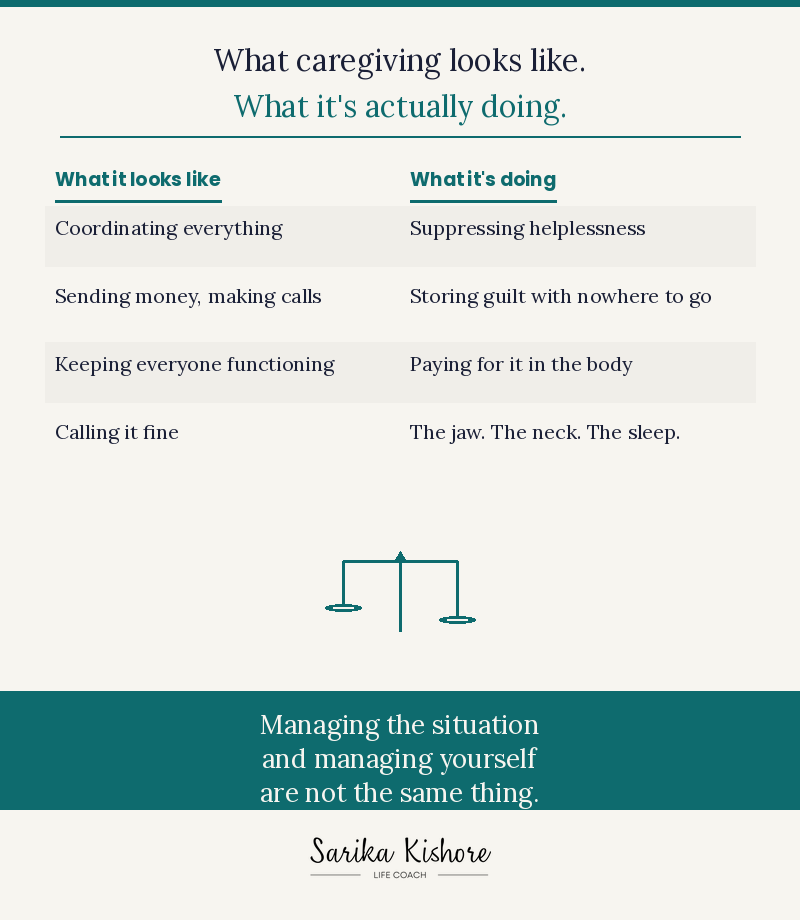
I coordinated with my brother and his wife, who were there. I sent money. I helped her process her emotions on the call. I kept everyone functioning. Including her.
I was good at this. I had always been good at this.
What I didn’t notice until my jaw locked and my neck seized and the TMJ I hadn’t felt in months came back was that I hadn’t done any of that for myself.
I used a massager. I took a painkiller. I waited for her to get better.
When she did, I called it fine.
It wasn’t fine.
The pain in my body wasn’t stress. It was helplessness that had nowhere to go. I had managed the situation completely. I hadn’t managed myself at all.
And that pattern – managing instead of feeling – had been living in my body for years.
—
If you’re an NRI caring for aging parents from a distance, you likely know this pattern well. Not because something is wrong with you. Because you learned it young and it works.
Until it doesn’t.
[78% of family caregivers report experiencing burnout](https://abc17news.com/stacker-parenting-family/2026/02/20/2026-caregiver-burnout-statistics-how-stress-shows-up-in-family-caregiving/) — and that’s among people who can actually get to their parents. For those of us managing from 12,000 kilometres away, the numbers don’t capture what it actually costs. Because what it costs doesn’t show up on a survey. It shows up in a locked jaw. A neck that won’t release. A body that stops cooperating.
The exhaustion isn’t the problem. The exhaustion is what happens when helplessness has nowhere to go for long enough.
—
Here’s what I’ve come to understand about why this happens — from doing this work on myself before I ever did it with anyone else.
When you can’t be there physically, managing becomes the only form of love available to you.
You coordinate. You send money. You make the calls. You hold the family together from across an ocean. And you do it well. Because doing it well is how you prove — to yourself and to everyone else — that the distance doesn’t make you less devoted.
This is where identity enters the picture.
For many of us, especially eldest children, being capable isn’t just a skill. It’s the story we have about who we are. Being the one who handles it. Being the one who doesn’t fall apart. Being the one everyone can count on.
So when something happens that you genuinely cannot handle — a parent getting hurt when you cannot go — the incapability is unbearable. Not because the situation is unbearable. Because it contradicts everything you believe about who you are.
And so the helplessness gets suppressed.
You move it into the background and move the management into the foreground.
And the body keeps the score.
—
This is what I call operating from State 3 — what I describe to clients as Handling It.
In this state, the internal monologue sounds like: “Just tell me what needs to be done.” “I’ve got it.” “Let’s move.”
It is extraordinarily functional. And it is extraordinarily costly.
Because State 3 operating from suppressed State 1 — the place that says “I don’t have a choice,” “I’m helpless,” “I can’t fix this” — doesn’t just drain energy. It stores it. In the jaw. The neck. The shoulders. The sleep. The body becomes the container for everything that has nowhere else to go.
The books tell you to breathe. To journal. To set boundaries. To practice gratitude.
These are not useless. But they treat the surface. They don’t reach the thing underneath, which is the identity that formed around never being the one who breaks.
No breathing exercise reaches that.
—
When I finally did this work on myself, here is what shifted.
Not what I did differently. What changed on the inside?
RELIEF
A knowing that I could work on it. That it could change. The exact opposite of the helplessness I had been suppressing for years.
That’s what Phase 1 of my program is designed to create.
Not a plan. Not a strategy. Not a list of things to do differently.
Clarity about what’s actually happening. Why do you go into handling mode? Where your identity is attached to it. What has it been costing you to keep going without looking at that?
I use the Energy Leadership Index with every client – a research-backed assessment that doesn’t label you, but shows you something that can genuinely change: the way you perceive the situations you’re in.
For NRI caregivers, what it almost always reveals is this:
You are not coping badly.
You are coping from a pattern that formed before you knew you had a choice.
And the moment you see that clearly – really clearly, not just intellectually – something releases.
That’s the relief I felt.
That’s what I watch happen with clients.
Not a breakthrough. Recognition.
From there, Phase 2 is about creating choice where you previously only had reaction.
Which gear are you actually in when you pick up that late-night call? Are you in State 3 – already managing before she’s finished her sentence? Or can you pause, recognize what’s happening inside you, and choose how you want to show up?
This is not about becoming someone who doesn’t care.
This is about becoming someone who can care without paying for it in their body.
Phase 3 is where the identity work happens. Examining the belief that your worth is tied to how much you manage. Not with judgment. With curiosity. Because that belief was formed by a person trying to do the right thing. It deserves to be met with respect – and with honesty about what it’s now costing.
What becomes possible on the other side:
You can feel helplessness without suppressing it.
You can be present on the call without bracing throughout.
You can rest after a hard conversation without your jaw deciding for you that there’s more to process.
You can still be the eldest child, still capable, still devoted, and also be someone who exists outside of that role.
—
I work with NRIs and busy professionals in the US and Canada who are caring for aging parents and beginning to feel the internal cost.
Caregiver Coaching for Busy Professionals.
If this is the pattern you’re living -managing instead of feeling, functioning on the outside, paying for it somewhere in your body – a 30-minute conversation might be the right next step.
Private. Grounded. No pressure – just clarity.
Book a 30-minute Discovery Call
FREQUENTLY ASKED QUESTIONS
Why do NRI caregivers struggle more with asking for help?
What is State 3 energy, and why is it a problem for caregivers?
Why don't self-help books and therapy fix this?
How is coaching different from therapy for caregivers?
—
KEY TAKEAWAYS
Managing is a form of love when presence isn’t possible. For NRI caregivers, coordination and logistics become the language of devotion. This isn’t a flaw. It’s an adaptation. The cost comes when it’s the only language available – when feeling is replaced by functioning, indefinitely.
The body keeps what the mind suppresses. Chronic jaw tension, neck pain, disrupted sleep – these are not stress symptoms. They are the physical location of emotions that had nowhere to go. The helplessness didn’t disappear. It relocated.
Identity is the missing piece that most approaches don’t reach. You can breathe, journal, and set boundaries without ever examining why you became the one who handles everything. That examination – done with curiosity, not judgment – is where real change begins.
Relief, not effort, is the signal that something has shifted. The opposite of helplessness is not control. It is the knowing that change is possible. That recognition is what Phase 1 of this work is designed to create.
Caregiving doesn’t break people. Containing it alone does. The goal of this work is not to stop caring. It is to stop paying for it in ways that were never necessary – and that you were never told you had a choice about.
━━━━━━━━━━━━━━━━━━━━━━━━━━━━━━━━━━━━━━━━