For NRI caregivers and long-distance adult children caring for aging parents — this is what chronic vigilance actually costs, and how grounded responsibility becomes possible.
Your Body Is Here. Your Nervous System Never Left.
And this is Tuesday. Not a crisis day. Just Tuesday.
What NRI Caregiver Anxiety Actually Is – And Why It’s Different
Most long-distance caregivers I work with describe their experience as anxiety. They are not wrong – it feels like anxiety. The chest tightness, the mental loops, the inability to fully inhabit the present moment.
But anxiety is a response to threat. What long-distance caregivers are actually living in is something more specific and more sustained: chronic vigilance. The internal state of constant readiness- scanning, monitoring, anticipating – that never fully disengages even when nothing acute is happening.
In the energy framework I use with clients, I call this the ‘Handling It’ state. On the surface, it looks functional: organized, responsive, in control. Underneath, it is a nervous system that has quietly relocated to another time zone.
Your body goes through the motions here. It makes coffee, attends meetings, and reads bedtime stories. But the deeper regulatory system – the one that determines how you sleep, how you recover, how present you actually are – that system is perpetually on standby for the call that might change everything.
Your body is here. Your nervous system never left. And the cost of that split is not just emotional — it is biological.
Research: Research from Ohio State University found that caregivers under chronic stress show telomere shortening equivalent to additional biological aging — and shorter telomeres in the T-cells that protect the body from infection.
The same researchers found wounds heal up to 24% more slowly in chronically stressed caregivers. Damjanovic et al., Journal of Immunology, 2007
Read that again slowly.
The stress of monitoring from a distance – the constant alert, the guilt loops, the rehearsed calm on every call – is not just emotionally exhausting. It is changing the cellular biology of your body. The immune system weakens. Inflammation increases. The body ages faster than it should.
And this is happening while you are functional. While you are managing. While from the outside, you look completely fine.
What It Does to Your Work — and the People Closest to You
Priya is a software manager in Vancouver. She has two direct reports, a product roadmap that was due last week, and a mother in Pune who had a fall three months ago. Since then, Priya has not had a single full-focus workday.
She is in her meetings. She is answering her messages. But she is also, simultaneously, calculating whether her mother took the afternoon medication, whether the hired caregiver showed up, and whether the shortness of breath her father mentioned last week needs a doctor’s visit.
Her manager hasn’t noticed yet. Her team has. They describe her as ‘distracted.’ She describes herself as ‘fine.’
She is not fine. She is what researchers call ‘presenteeism’ – physically at work, cognitively somewhere else.
Research: A 2022 national study found that nearly 1 in 4 employed family caregivers reported either absenteeism or presenteeism in a single month due to caregiving responsibilities.
The hidden productivity cost is often larger than the visible one. Fakeye et al., Innovation in Aging, 2022
At home, it shows up differently. Priya’s husband gets the version of her that has already used up its attention. Her children get the version that is three steps behind in the conversation because part of her mind is still in Pune.
She snapped at him last Thursday over something small. She cried in the bathroom afterward, not because of the fight but because she doesn’t recognize the sharpness that’s been arriving lately.
This is what chronic vigilance does to the people around you. It doesn’t announce itself. It just slowly narrows what you have to give – until the people closest to you are receiving the leftover version of someone they love.
Research: Longitudinal research shows caregiver burden consistently predicts increased work-family conflict and family-work conflict over time —
with strain-based conflict (not just time) being the most damaging mediator between caregiving load and mental health deterioration. Gordon & Whelan-Berry, PMC, 2021
The Guilt That Keeps the Loop Running
None of this is caused by not caring enough. It is caused by caring in a particular way – a way that has become fused with distance guilt.
NRI caregivers, and particularly those from South Asian families, often carry an internalized equation that says: love = physical presence. Since physical presence is impossible, the mind compensates by being perpetually present in thought. The mental monitoring becomes a substitute for the body that cannot be there.
But here is what that equation misses: your parents don’t need your nervous system on standby 24 hours a day. What they need is a version of you that is clear, grounded, and genuinely available when you connect.
You cannot offer that from a state of chronic alert. And the guilt that drives the alert is not protecting anyone. It is, in fact, the primary thing preventing you from showing up the way you want to.
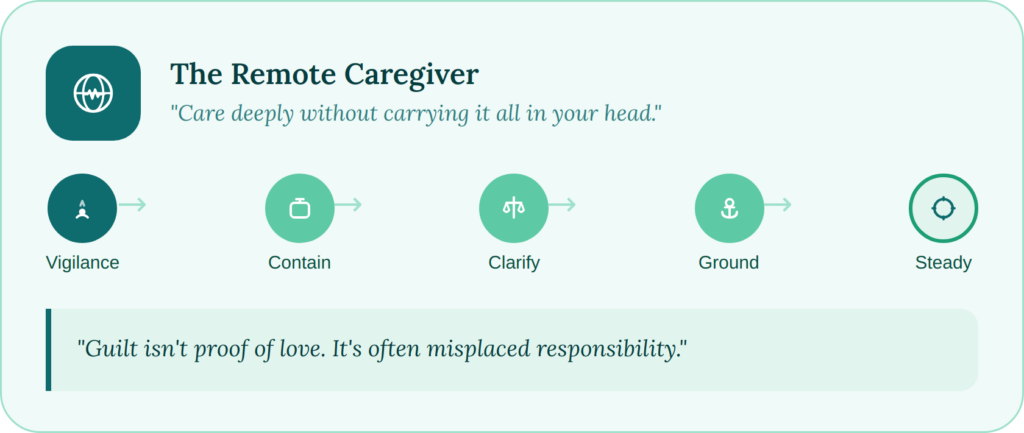
Guilt isn’t proof of love. It’s often misplaced responsibility. And you are allowed – you need – to tell the difference.
What Creating Choice Actually Looks Like From Here
I want to be specific about what shifts when NRI caregivers do this work. Because it is not about caring less. It is about carrying differently.
When Priya – or someone like her – begins to work with me through my Caregiver Coaching program, we start with the same question: Are you caring for your parents, or are you bracing for them?
Caring is an act of presence. Bracing is a sustained state of anticipation. They look identical from the outside. Inside, they are entirely different. One is sustainable. The other is what we’ve been describing.
Through the three phases of our work together – See Clearly, Create Choice, and Recognize Yourself – what shifts is the internal state that sits underneath the caregiving.
See Clearly
Contain: We name what the nervous system has been carrying – specifically, precisely – so it stops leaking into everything else. The sleep, the focus, the sharpness at home.
Clarify: We separate actual responsibility from absorbed guilt. This is not a philosophical exercise. It is a lived, embodied distinction that changes how the body responds to incoming news.
Create Choice
Realign: We shift from vigilance-as-love to groundedness-as-love. The calls still happen. The coordination still happens. But it happens from a different internal place.
Recognize Yourself
Integrate: We build a repeatable way to return to center – before the call, after the hard update, and during the three-day spiral. A path back that doesn’t require the situation to get better first.
The distance doesn’t disappear. But what you’re living in between the calls does change. Clients often describe it this way: ‘I’m still responsible. But I’m not living there anymore.’
You don’t need your life to calm down to come back to yourself. You need a different way of being inside this life.
For long-distance caregiver coaching- Book a 30-minute Discovery Call
We will get honest quickly about what your system is carrying, where the vigilance is coming from, and whether this work is the right next step for you.
Private. Grounded. No pressure – just clarity.