A live-in caregiver snaps at the mother-in-law she has cared for out of love, then lies awake convinced she has turned into someone cold. She has not. What has actually worn through is not her capacity to love, but her capacity to show it under more weight than one person can carry.
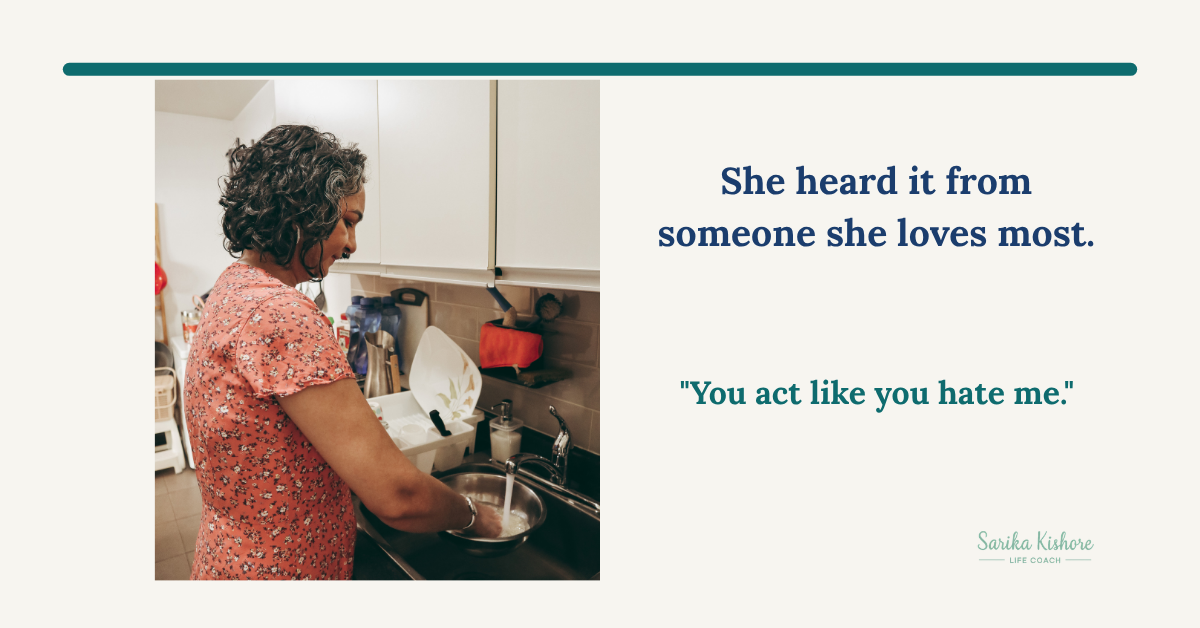
My mother-in-law asked me where her glasses were three times before the kettle had even boiled. They were on the chain around her neck, where they always are. The fourth time, I did not turn around. I just said it, flat and hard. "They're around your neck, Ruth." I heard the edge in my own voice before the words were even finished. I felt her go quiet behind me.
Then she said the thing I have not been able to put down since.
She said, "You act like you hate me."
I have heard a version of that sentence from a lot of the women I work with, so I want to stay with it for a moment. I am going to call her Stella, though she could be almost any of them.
Stella does not hate Ruth. Stella teaches high school, and three years ago, when Ruth (her mother-in-law) could no longer manage the stairs in her own flat, it was Stella who suggested she move in, before anyone had to ask her to. Ruth picked the children up from school for years. Leo (her son), who is nine, learned his times tables at Ruth’s kitchen table. Maya (her daughter), who is fifteen, still wears the grey cardigan Ruth knitted her two winters ago. The love in this house is real, and old, and it has not gone anywhere.
What has gone is harder to point at, so most people, Stella included, mistake it for a change in who she is. She used to read Ruth the headlines in the afternoon, because Ruth’s eyes tire by two o’clock, and the two of them did the Saturday crossword together. She does not have time for any of that now. Between the school day, the children, and everything Ruth needs, the small things she used to enjoy with Ruth have fallen away one at a time, and she has lost count of how many are gone. She used to be the patient one. Last week she snapped at Leo for leaving his shoes in the hallway and watched him go still in the way children do when they are quietly recalculating who you are. She used to tell her husband Mark about her day. Now they eat dinner with the television on, so the silence has something to stand behind.
The guilt comes at her from every side at once. Guilt that she is short with a woman who gave her children their childhood. Guilt that Leo flinched. Guilt that Maya has started carrying her plate up to her room. Guilt that she cannot remember the last time she and Mark laughed at the same thing. She is trying to hold a mother-in-law, a marriage, and two children steady at the same time, and she has decided, somewhere in the back of her mind, that she is failing all four of them.
So she lies awake and asks the only question that seems to fit. Whether the woman who snapped at the stove, sharp and tired and cold to someone she loves, is simply who she is now.
She is not who she fears she has become. Something specific has come apart, and it is worth seeing plainly before deciding what it means about her.
I have not stopped loving her. I have run out of room to show it.
That is the truth underneath the sharp voice, and it is almost never the truth people reach for first. What has come apart in Stella is the link between her behavior and her feelings. The love is intact. The ability to show it warmly, in the moment, under this much weight, is the part that has worn through. If a caring person is getting sharper, it is usually not the personality that is changing. It is pressure that has run out of options.
A live-in caregiver is never fully off the clock. There is no drive home that ends the shift, because the home and the shift are the same four walls. Stella keeps a baby monitor on her nightstand now, so she can hear if Ruth gets up in the dark and reaches for the stairs. She has not slept through a night in months, and her hardest days are the ones that follow a broken one.
A study in the Journals of Gerontology found that family caregivers reported more anger on their higher-stress days, with the anger climbing and falling alongside the day’s demands rather than reflecting anything fixed about the person.
Stella’s sharpness is not a new character. It is a reading on the load she carried that particular day.
When did your voice last go sharp before you had decided to be sharp? If a friend described your week back to you, would the word that came to mind be cold or overwhelmed? Did you snap because you have become a mean person, or because you had no energy left to be patient?

The guilt has its own machinery, and it misleads her.
Researchers who study family caregivers have described caregiver guilt as a frequent and disabling emotion that rarely gets named or treated, even though it quietly steers how people cope.
The cruel part is that the guilt tends to fall hardest on the people who took the role on out of love, because they are the ones who expect themselves to carry everything and stay gentle while they do it. That is the expectation breaking, not the love. This is what caring for aging parents guilt usually is at its root. It is not evidence that the feeling has changed. It is misplaced responsibility, applied to a load no one could carry that way for long.
There is a name worth knowing for the deeper thing happening to Stella. Call it caregiver identity erosion, the slow wearing down of the person you were under the constant, unbroken weight of care.
The Family Caregiver Alliance describes how caregiving can bring a loss of self-identity.
For Stella, that is not a metaphor. It is the afternoons, reading the headlines and doing the crossword with Ruth, the patience she used to have with Leo, the easy conversation she used to have with Mark, each one quietly dropped because there was no room left in the day to hold it. Erosion is not dramatic. It is a hundred small things you stop doing, one at a time, until you look up and the person who did them seems to be gone.
And the load does not stay where it starts. When one person absorbs an entire household’s worth of care, the strain leaks. Stella holds the worry about Ruth, and Mark feels the cold edge of a wife who has nothing left by nine in the evening. Leo asks for help with his reading at the wrong moment and gets a sigh instead of a yes. Maya watches the tension move through the kitchen and reads it as her mother going hard and distant, when in fact her mother has been stretched past the point at which any person can stay soft. The guilt multiplies because Stella is convinced she is failing on four fronts. She is not failing on four fronts. She is overextended on one, and it is spilling into the other three.
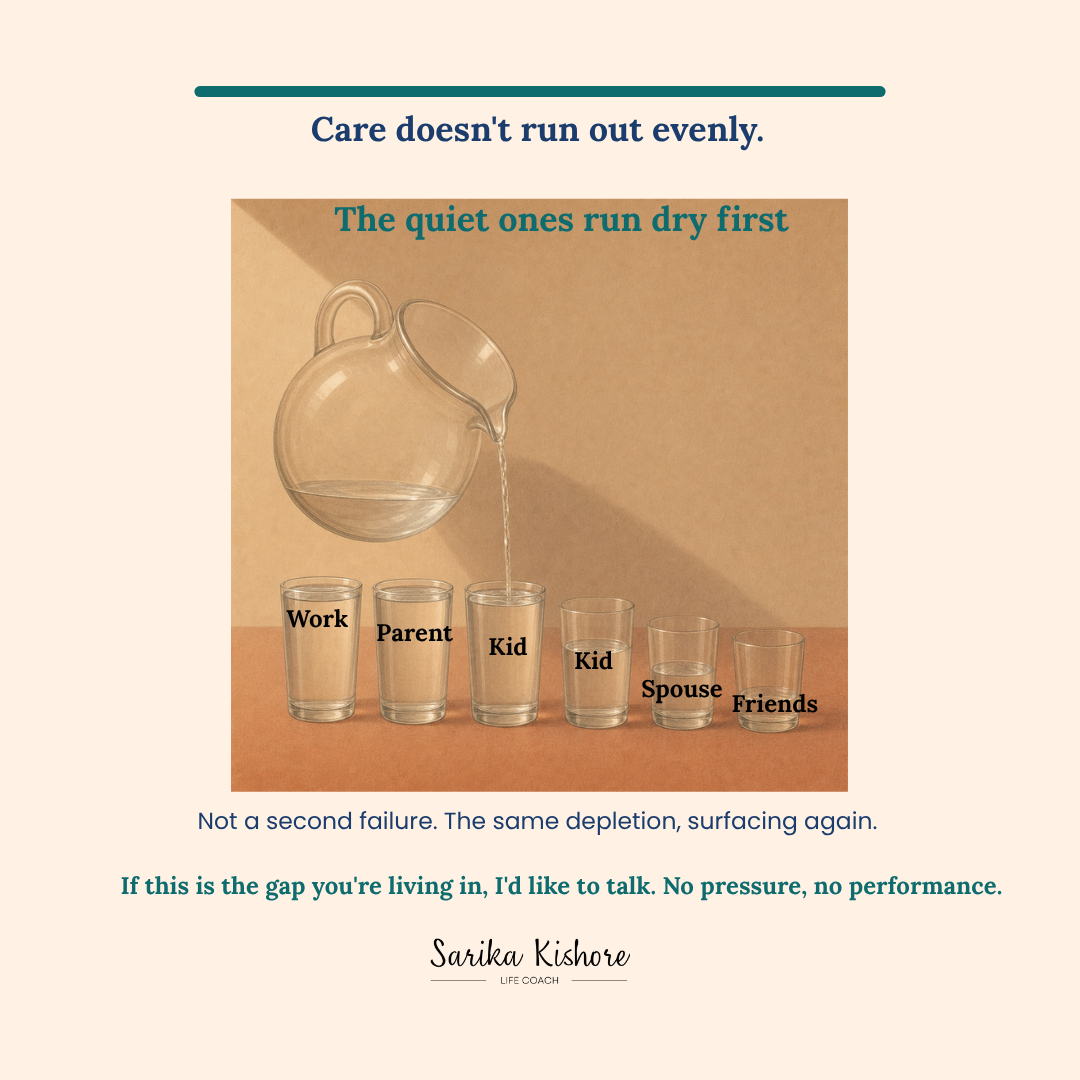
What were you like with her, before there was this much to carry? When your child went quiet, was it because you had become a worse mother, or because there was nothing left in you by the time you reached them?
This is the point where the work begins, and it follows a path.
The first move is to see the pattern clearly, before changing a single thing. When Stella stops reading her sharpness as proof that she has gone cold, and starts treating it as information, the shape of it appears. The edge shows up after broken sleep. It shows up when three people need her in the same ten minutes. It shows up at the end of the day and almost never at the start. That is not a character flaw with a schedule. That is a depleted system reaching its limit at predictable times. Seeing it this way is a relief, and it is also the first real piece of leverage she has had in a long while.
Once the pattern is visible, choices appear that the pressure had hidden. Mark could take the monitor two nights a week so Stella sleeps, which he would gladly do if anyone had ever named the problem out loud. Ruth’s most demanding care could move to the morning, when Stella is resourced, instead of the evening, when she is empty. Stella could tell Maya the plain truth, that she is tired and stretched, and it has nothing to do with her, so her daughter stops filling the silence with a worse story. None of these are visible when you are braced and simply trying to survive the day. They come into view the moment you stop reading your own behavior as a verdict.
And then comes the slow part: rebuilding the person the role had crowded out. The afternoons with Ruth come back, not because the caregiving has gotten lighter, but because Stella is no longer running on empty when she sits down. She apologizes to Leo, and he comes back to her the way children do, fully and quickly. She and Mark have one honest conversation, the first in a while, and it does not fix everything, but it ends the pretending. Stella does not become a different woman. She becomes the one who was there before the weight of it all closed in.
This is the work I do with busy professionals, many of them holding a parent and their own kids at the same time, the way Stella is. We start by seeing the pattern clearly, we find the choices the pressure has been hiding, and we rebuild the parts of you the role has been quietly eroding. Steadiness comes first. Strategy follows it.
Stella’s story is not unusual, and if your kitchen sounds like hers, the sharp voice is worth listening to differently. It is not telling you that you have stopped loving anyone. It is telling you that you are carrying too much, alone, for too long. You do not need the house to fall quiet to come back to yourself. You need fewer things resting on you at once.
If someone close to you recently said something that landed hard, and your first instinct was that they were wrong, I would gently invite you to sit with it a little longer before you set it aside. And if you are ready to look at what is running underneath the sharpness, I would like to be part of that conversation.
No pressure. No performance required. Just an honest conversation about what this season has actually been costing you.
Frequently Asked Questions
Why am I so angry at my aging parent?
Is caring for aging parents guilt normal?
What makes live-in caregiving so emotionally hard?
How do I handle the guilt toward my children while caring for an aging parent?
Does resenting the parent I care for mean I love them less?
Key Takeaways
Behavior and feeling come apart under sustained pressure. A sharp voice toward someone you love is usually a sign that your capacity has been exceeded, not a sign that the love underneath has changed.
If a caring person is getting sharper, it is rarely the personality that is changing. Caregiver anger has been found to rise on the heaviest days and ease on the lighter ones, which means it is information about the load you carried, not a verdict on who you are.
When caring for aging parents, guilt falls hardest on those who took on the role out of love, because they expect themselves to hold everything together and stay gentle at once. That expectation is what breaks, not the love.
Caregiver identity erosion is concrete, not abstract. It is the specific things you stop doing, the afternoons together, the patience, the easy conversations, dropped one at a time until the person who did them seems to be gone.
When one person absorbs a household’s entire load, the strain leaks into every relationship in the house. The guilt then multiplies across a marriage and children, when the real problem is one person overextended on a single front.