Live-in caregiver stress rarely looks like a crisis from the outside. The person managing everything efficiently is often the person most depleted. What breaks the pattern is not a collapse. It is the moment the people around her start reacting.
She posted in a Facebook group asking for breakfast ideas for her elderly mother.
She was not looking for variety. The thing that had been working for months had just stopped working, and she had twenty minutes before the school run, and she needed a new answer before the day could start.
Her mother wakes anywhere between 7am and 1pm. She cannot use the toaster safely. She will not touch anything unless it is placed directly in front of her. The eggs worked for a long time. But this week she said no more eggs.
So now there is a new problem to solve before work, before the school run, before anything else gets to exist that morning.
The person posting was not complaining. She was doing what she always does: finding a practical solution so she could keep moving.
Most people reading that post saw a resourceful woman managing a hard situation. I saw something else.
This is what live-in caregiver stress actually looks like from the outside.
At some point, the people around this woman will start reacting to her. A colleague will say something carefully. A child will tell her, in the blunt way children do, that she has been scary lately. A partner will go quiet in a way that says more than words.
And she will feel completely justified.
Because she is managing the breakfast logistics, the medication schedule, the school run, the work deliverables, and the emotional temperature of everyone in the house. Of course she snapped.
She is not wrong about the load. But justified and accurate are two different things. And the people around her are telling her something real.
What does it cost you, after you have lost it on someone? Not what it costs them. What does it cost you?
When women experiencing live-in caregiver stress come to me, they do not come because they are falling apart. They come because the productivity loop has stopped working. The systems are in place. And yet something keeps breaking through: the impatience, the sharpness, the way a small request from a child can land like an outrage.
The first thing I do is ask about the daily routine. And then I ask a different question.
How do you feel when you wake up in the morning?
The answer is almost always one of two things.
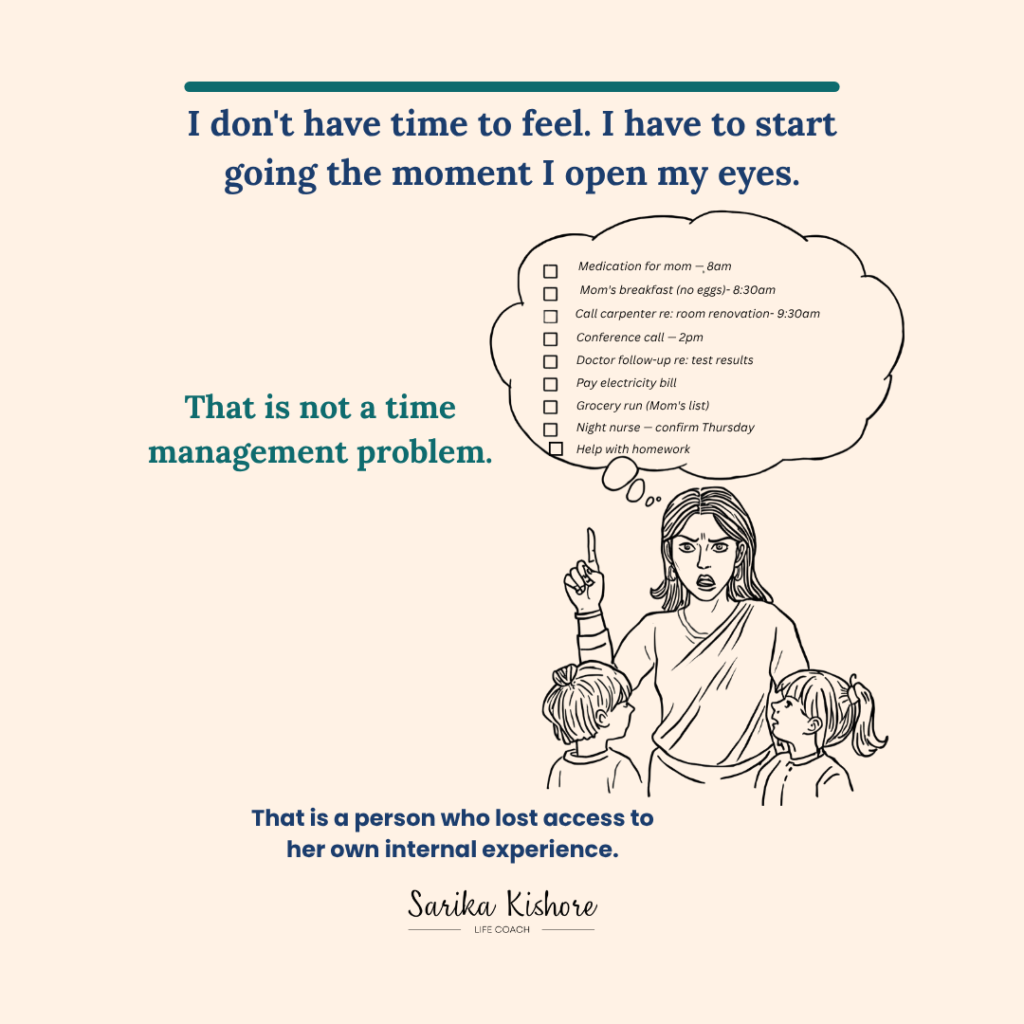
"I do not have time to feel. I have to start going the moment I open my eyes."
Or: "I do not even know where I am. I am just managing every day on repeat."
That is not a scheduling problem. That is a person who has been deferring her own internal experience for so long that she has lost access to it.
Research on adult children caring for aging parents in home settings supports what I hear consistently. A 2025 study published in PLOS One found that live-in caregiver stress is amplified by the unpredictable, daily-changing nature of the parent's needs, and that caregiving shapes the caregiver's own identity over time in ways that often go unexamined.
The to-do list is real. And it is also doing something else.
When I ask what these systems are really hiding, the actual reason behind needing everything organised and controlled, something shifts.
Not dramatically. Just a pause, and then a slow recognition.
Because the honest answer, underneath the efficiency, is this: if I let go, things will fall apart. And I do not have the energy to clean up someone else's mess on top of everything I am already carrying.
Except it is not sustainable. And she knows it. Because if it were sustainable, the people around her would not be reacting the way they are.
Could you let someone else manage one task today and not intervene when they do it differently? What happens when you sit with that question?
Research suggests live-in caregiver stress is not simply a matter of personality. A 2024 review found that depleted self-control creates more interpersonal conflict, and more conflict leads to further depletion. Researchers describe this as having ominous potential for vicious circles. This is a resource problem, not a character problem.
For most of the women I work with, the answer to the delegation question is no. Not because they are controlling. Because imperfection feels indistinguishable from failure.
When I ask who is actually setting the bar, who decided everything had to be done this way without delegation and without error, the answer is almost never that someone else told me to. It is always: I did.
That is the real load. The external demands are real. And the internal standard is what makes them energy expensive.
What do you believe will happen if you fall short of what you expect from yourself?
Research published in the Journal of the American Geriatrics Society found that sandwich generation caregivers managing both an aging parent and children at home were twice as likely to report financial difficulty and significantly more likely to report substantial emotional difficulty. Sandwich generation emotional support is not a luxury. It is what keeps the system from breaking.
Recognition does not remove the breakfast problem. The logistics are still real.
But something changes when a person can see clearly what has been driving her behavior.
I have been running on fear of my own failure, and I have been asking the people around me to absorb the cost of that.
Seeing that is what creates a choice. The option to let something be imperfect. The option to feel something rather than manage it. The option to come back to herself, briefly, before the next problem needs solving.
You do not need your life to calm down to come back to yourself. You need to understand what has been driving you, so you stop paying for it with the people who matter most.
If someone recently said something to you that landed hard, and your first instinct was that they were wrong, I would invite you to sit with it a little longer before dismissing it.
And if you are ready to look at what is underneath the efficiency, I would like to be part of that conversation.
No pressure. No performance required. Just an honest conversation about what this season has actually been costing you.
Frequently Asked Questions
What does decision fatigue look like in caregivers?
Why do I keep snapping at my kids or partner when I have been patient all day with my parent?
I am good at managing things. Why is everything getting harder?
Is it true that I just need a break?
What does coaching actually do in a situation like this?
Key Takeaways
The live-in caregiver who snaps is almost never losing control. She is running out of regulated capacity after a day of sustained holding. Research on ego depletion suggests depleted self-control creates interpersonal conflict, and conflict creates further depletion. The overflow goes to the safest people. That is data about accumulated live-in caregiver stress, not evidence of who she is.
The control systems are not only coping strategies. They are protection against the fear of falling short of a standard she has set for herself. The external load is real. The internal standard is what makes it unsurvivable.
Recognition is what creates choice. Seeing clearly what has been driving the behavior, the fear underneath the competence, is what makes a different response available. The breakfast problem does not go away. The person solving it gets some of herself back.
Sandwich generation emotional support is not supplementary to the caregiving. It is what makes it sustainable. Research consistently shows that those managing both an aging parent and children at home carry a measurably heavier load. That load has a name. And it has a way through.
Sarika Kishore is an iPEC-Certified Coach and ELI Practitioner based in Toronto, working with busy professionals and NRIs in the US and Canada who are caring for aging parents. sarikakishore.com
You might also find this useful
- When Resentment Is Not a Failure of Love [Sarika to confirm URL]
- The Hidden Weight of Caregiving: A Guide for Live-In Caregivers [Sarika to confirm URL]
- Caregiver Coaching for Busy Professionals