Cory flew across the world to sit with his dying mother, and in that hospice room he wished it would be over. He wished it for her. He has not forgiven himself since. This is what that wish actually is, and why hospice caregiver guilt is rarely the betrayal it feels like.

God, take her peacefully. Right now.
Then he went very still. A son is not supposed to wish that. If you have ever sat in a chair like that one, you already know the feeling that arrived next. This is hospice caregiver guilt, and it is far more common than the silence around it would ever let you believe.
Cory had flown from Toronto to sit beside his mother in a hospice in India. The dementia took away her ability to know him some time ago. The autoimmune disease is taking the rest now, slowly, with a lot of pain. She does not understand what is happening to her body. He can see she is frightened, and there is no version of her left that he can reach to comfort. So he held her hand and asked God why she had to suffer this much, and why he had to watch it. The wish came right behind the question.
For a year, he has run her care from another country. He knows the time difference without doing the math. He pays for everything she needs. He coordinates the hospice, the relatives who still visit, and his father, who sits beside her and is aging and grieving a wife who is still alive. Caring for a dying parent from another country splits you. Your body is here. The person you are losing is there. Neither place gets all of you.
He used the last of his leave for this visit. It is June. He has none left this year, and he does not know if he will see her again before she dies.
So one question runs on a loop.
Should he leave his job?
He is a senior partner who built that career over decades. Should he set it down to be with a mother who will not know he came? Or stay, keep the income that pays for her care, raise his children through a shared-custody schedule that needs him steady, and brace for a grief he can already feel.
When you turn a question like that over, are you weighing real options? Or running the same loop faster each time, with no way out?
The wish at the bedside and the question on the loop come from the same place. He has carried too much, for too long, with almost no one to hand any of it to. Caregiving does not break people. Carrying it alone does.
There are names for what he is living. Anticipatory grief is grieving someone before they die. Ambiguous loss, a term coined by psychologist Pauline Boss, is grieving someone who is still physically here but psychologically gone, which is exactly what dementia does. Cory has both at once. He started losing his mother years ago, memory by memory, and he is losing her again now.
Research suggests anticipatory grief is one of the most common experiences among family caregivers of someone with a terminal or progressive illness, and that, left unnamed, it raises the risk of depression and a harder grief after the death.
The wish for her suffering to end is not a failure of love. He has been grieving her for years, and the wish came straight out of that grief.
When you wished it would be over, what did you actually want to end?
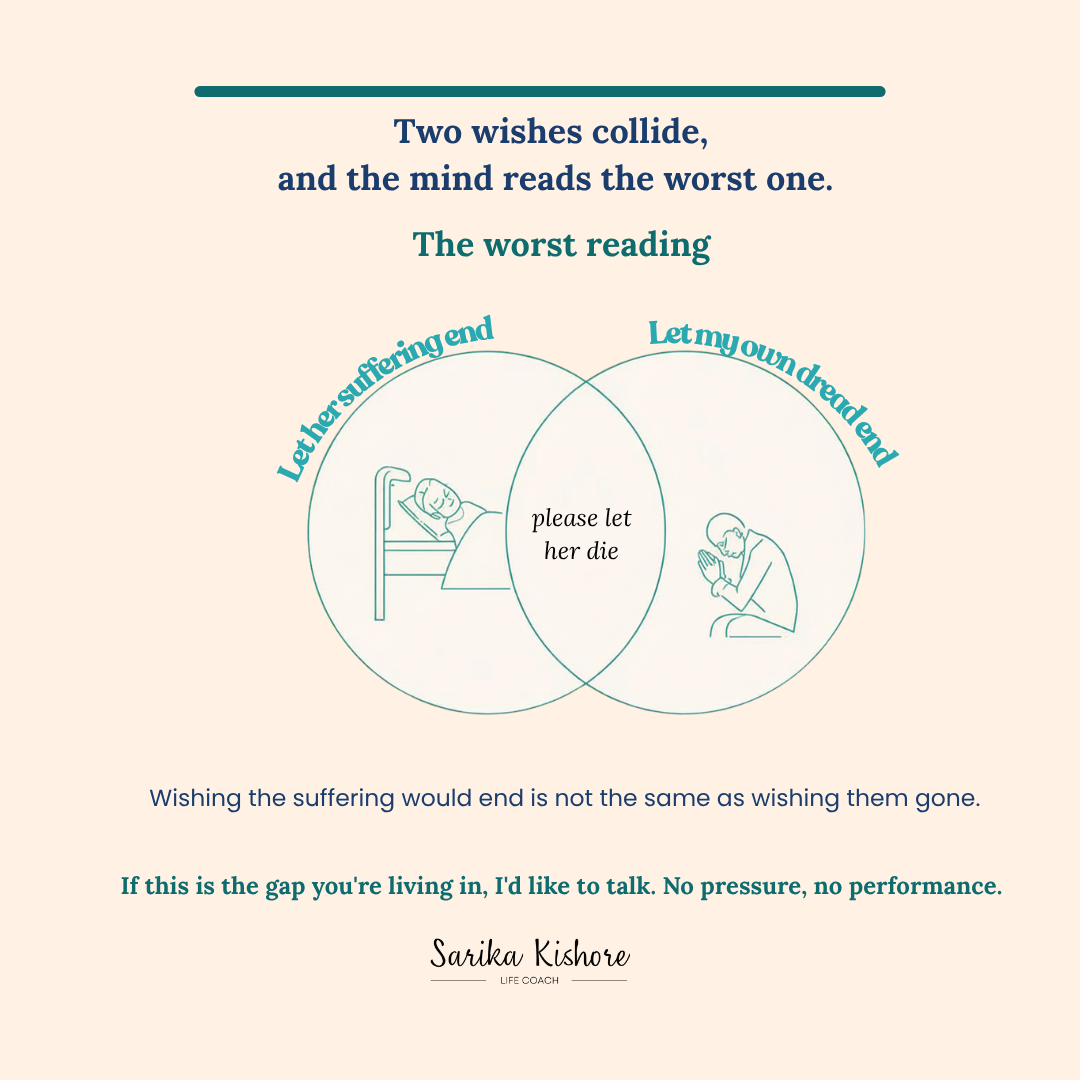
Two wishes show up together in a room like that, and they get mistaken for one. There is a wish for her pain to stop. And there is the wish for your own dread to stop. In caregiver forums, people say it without flinching.
One caregiver writes that she just wants the person to finally have some peace, and honestly, for everyone worn down around her to have some, too.
Wanting your own relief does not cancel your love. It means you are a person, and you are tired in a way sleep does not fix.
There is something else working against Cory that he cannot see. He is a man, and he is performing fine for everyone.
Research suggests men's grief is routinely underestimated. Clinicians long assumed women grieve harder, but a review by psychologists Wolfgang and Margaret Stroebe found that once you account for the higher baseline rate of depression among women, men actually suffer more from being bereaved.
Cory looks composed at work and steady for his kids. That is not the measure of what this is costing him.
Wishing her suffering would end is not the same as wishing her gone.
You can want her pain to stop and want every extra morning you might still get. The mind keeping this watch does not file these neatly. It collapses them into one guilty feeling and hands you the worst reading of yourself. That is the engine under most hospice caregiver guilt.
This is where my work starts. Not by telling Cory whether to quit. By showing him where he is deciding from. He moves between two states. The first is Stuck, where it feels like there is no choice, and you just keep going. The second is Handling It, where you look fine and manage everything while the rest keeps getting postponed until it disappears. Both are exhausting. Neither is a place to make a decision this size from.
The shift is toward a connected, calm state, which I call Steady. You can care without absorbing, and be present without bracing. The situation is still hard. It stops running you. From there, the job question stops being a panic between two punishments and becomes a choice he can actually make and live with. What would Cory decide if he were not deciding from exhaustion?
No one jumps from Stuck to Steady. The route runs through a smaller shift first, Stepping Back, where a little space opens between what happens and how you respond, and real options appear. That is how the method moves. See clearly where you are. Create choices you could not see before. Then recognize the person you still are underneath the role.
Cory's real question was never only the job. It was who he could ask for help. He has friends and colleagues who care, but work needs him fine, and his children need him fine, so he stays fine for all of them. His father is too deep in his own grief to hold any of Cory's. The relatives have their own lives, and it has been a long time. The help fades right when the caregiving has run its longest. You are responsible for her care. You were never meant to carry it alone.
His mother is still here. So is Cory, including the parts worn past what rest can fix. The wish at her bedside was not the truth about his love, and neither is the guilt. It came from a man who has managed his mother's dying across an ocean for a year, with too little help.
You do not need this season to ease before you can come back to yourself. You need somewhere to set down a part of what you have been carrying alone.
When did you last let yourself feel the relief without reaching for the guilt to cancel it?
If this is the chapter you are in, you do not have to keep holding it by yourself. I offer a 30-minute conversation for busy professionals, many living in the US and Canada while a parent is unwell elsewhere. No pressure. No performance. Just a clear conversation about what this has been costing you.
Frequently Asked Questions
Is it normal to feel guilty when a parent dies?
What is hospice caregiver guilt?
How do I cope when I am caring for a dying parent from another country?
Does feeling relief mean I loved my parent less?
What is the difference between anticipatory grief and ambiguous loss?
Key Takeaways
The wish for a parent's suffering to end is not a wish for them to be gone. After a long illness, relief and love run on two tracks. The relief is the weight lifting. It is not a measure of how much you love them.
With dementia, you grieve twice. You grieve the parent fading in front of you now, and the parent who is already gone. This is anticipatory grief and ambiguous loss together. Naming them is not abandoning your parent. It is how you stay upright through a goodbye that lasts years.
Hospice caregiver guilt is rarely a sign that something is wrong with you. It is usually a sign that you have been containing too much, alone, for too long, with no one to hand any of it to.
A decision as large as leaving your career should not be made from Stuck or from Handling It. From a steadier place, the question stops being a panic between two punishments and becomes a choice you can actually own.
Caring for a dying parent from another country splits you in two. Your body is here. The person you are losing is there. The answer is not more guilt. It is more support, and one place to set the weight down.