For long-distance caregivers who are also running a business or career, the health crisis often arrives not from neglect but from sustained high-functioning. This post is about what happens when the body stops cooperating while the mind keeps going, and what actually shifts it.

When Anu came to me, the first thing she said was: “I don’t know what else to do.”
She wasn’t ignoring the problem.
She was meditating every morning.
She had a therapist.
She had been working on herself for years.
And she hadn’t slept a full night in years.
She wasn’t someone who gave up easily. She had a new business she cared about deeply. She was building something. She was also managing her mother’s care from overseas, coordinating across time zones, making calls at odd hours, carrying the weight of a situation she couldn’t physically reach.
She had been doing everything right.
Her body had not gotten the message.
Her doctor found it in the numbers. Cortisol so elevated it was working against every effort she made. She had been trying to lose weight for over a year. Her parameters kept getting worse. Her doctor told her directly: this is not a diet problem. This is an emotional resilience problem. Work on that first.
Her body had been keeping score while her mind kept functioning.
She came to me because she had tried the things on the list. Breathe. Journal. Meditate. Set limits. Practice gratitude. Rest more.
Did you try those things? I asked.
Yes.
And?
It helped a little. But I’m still the same person in the same situations reacting the same way.
That sentence is the most important one. Not because something was wrong with her. Because she was describing exactly what happens when you treat symptoms without touching the thing underneath.
The meditation was managing her nervous system in the moment.
The therapy was processing what had happened.
Neither one was asking the question that actually mattered.
Who did you become in order to keep everything running? And what is that costing you now?
For long-distance caregivers who are also professionals, entrepreneurs, people with full lives they are trying to hold together, there is a particular kind of exhaustion that doesn’t show up on a survey.
It is the exhaustion of high functioning.
You are not falling apart visibly. You are showing up. You are delivering. You are managing the caregiving from a distance with a level of coordination that most people couldn’t sustain.
And underneath all of that, the nervous system is running a background calculation that never stops.
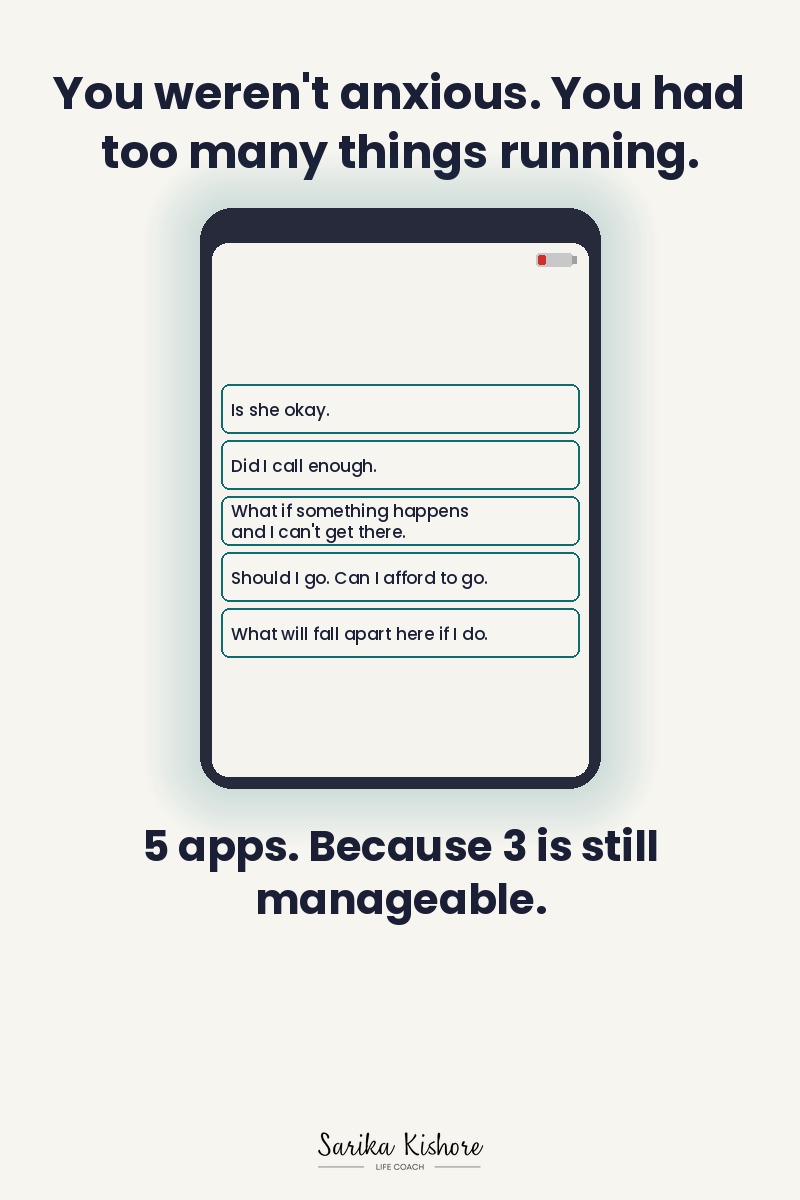
Is she okay. Did I call enough. What if something happens and I can’t get there. Should I go. Can I afford to go. What will fall apart here if I do.
According to a 2025 AARP and National Alliance for Caregiving report, 78% of family caregivers report experiencing burnout. What that statistic doesn’t capture is the subset who appear completely functional. Who aren’t dropping balls at work. Who aren’t missing appointments. Who are, by every external measure, fine.
Until the body makes a different report.
Functioning well on the outside is not the same as carrying an appropriate load. The body knows the difference even when the mind has stopped asking.
What Anu needed wasn’t a better meditation practice.
She needed to understand what her nervous system was actually responding to.
Not the surface anxiety. The pattern underneath it.
The belief that if she stopped watching, something would slip.
The identity that had formed around being the one who holds it together.
The grief of watching her mother get sicker from a distance, quietly, without anywhere to put it.
None of that was reaching the surface in her meditation journal.
None of it was being touched by the breathing exercises.
It was living in her body. In the cortisol. In the sleeplessness. In the weight that wouldn’t shift no matter what she tried.
This is the first phase of the work I do with clients, which I call See Clearly.
Not a plan. Not a new strategy. A precise understanding of what is actually running, and why.
I use the Energy Leadership Index with every client. A research-backed assessment that shows something specific and changeable: the way you perceive the situations you are in. For caregivers like Anu, what it almost always reveals is this.
You are not coping badly. You are coping from a pattern that formed before you knew you had a choice.
That recognition, when it lands, is different from understanding something intellectually. It is a shift in the body as much as the mind.
The moment you see the pattern clearly, you have a choice you didn’t have before.
From there, the work moves to creating choice where previously there was only reaction. What mode are you actually in when you pick up that late-night call? Are you already bracing before she’s finished her sentence? Or can you pause, notice what’s happening inside you, and decide how you want to show up?
This is not about caring less.
It is about stopping the body from paying a tax it was never meant to pay.
Anu sleeps now.
Not every night perfectly. But the 3am calculations have stopped running on their own.
She recognizes when she is heading into freeze mode and adjusts her work around it instead of pushing through it.
She follows her treatment plan with a focus she didn’t have before.
Her numbers are moving.
She is the same person. In a different relationship with what she is carrying.
That is what changes.
Not the situation. Not the distance. Not her mother’s illness.
The internal load her system was running in response to all of it.
The emotional support that adult children caring for aging parents actually need doesn’t begin with a better coping technique. It begins with being seen inside the specific bind they are in. The guilt, the distance, the health cost, the body that has been keeping score without being asked.
That’s what this work is.
I work with NRIs and busy professionals in the US and Canada who are caring for aging parents and beginning to feel the internal cost.
If this is the pattern you’re living, functioning on the outside, paying for it somewhere in your body, a 30-minute conversation might be the right next step.
Not a sales call. Not a strategy session.
Just an honest conversation about what this has been costing you and whether this work is the right fit.
Private. Grounded. No pressure.
Frequently Asked Questions
Why is my body breaking down when I’m still functioning normally?
High functioning and low internal load are not the same thing. Many caregivers, especially those managing from a distance while holding down careers or businesses, appear completely capable on the outside while their nervous system is running a constant background calculation that never fully stops. The body registers that load even when the mind has learned to override it. What looks like a diet problem, a sleep problem, or an unexplained health issue is often the body’s way of reporting what the mind stopped asking about.
Why am I so angry at my aging parent when I love them?
Anger in caregivers almost never means what it appears to mean. It is rarely about the specific thing that triggered it. It is usually the signal of a system that has been absorbing more than it can process, for longer than was sustainable. When the anger arrives, it is information. Something has been running at cost and the body is finally reporting it. The question worth asking is not what’s wrong with you. It is what has been running underneath everything, quietly, without you naming it.
Why isn’t therapy or meditation working for caregiver exhaustion?
Therapy and meditation treat real things. Anxiety symptoms, reactive patterns, the residue of specific events. What they don’t reach is the identity that formed around the role. The belief that being capable is who you are, not just what you do. The pattern that says if you stop watching, something will slip. Those patterns don’t respond to breathing exercises because they aren’t surface phenomena. They are structural. Understanding them requires a different kind of work.
Can the physical symptoms of caregiver exhaustion actually improve?
Yes. When the internal load decreases, the body responds. Not always immediately and not always in a straight line. But cortisol levels, sleep quality, focus, and physical symptoms that had no apparent medical cause have all shifted for clients who did this work. The body was never the problem. It was reporting a problem. When the source of the load changes, the report changes too.
What is the difference between caregiver burnout and what you describe?
Burnout is a depletion state. It describes what happens when you have given more than you had for long enough. What I work with is the pattern that creates the depletion in the first place. The identity that formed around the role. The belief systems that make stopping feel like failure. The emotional load that gets stored in the body because it has nowhere else to go. Addressing burnout without addressing the pattern means recovery is always temporary. The same load rebuilds.
Key Takeaways
High functioning is not the same as carrying an appropriate load. Many caregivers who appear completely capable on the outside are running a sustained internal calculation that their body is registering as a health crisis. The absence of visible collapse is not the same as the absence of cost.
The body keeps what the mind overrides. Cortisol elevation, disrupted sleep, unexplained physical symptoms and weight that won’t shift are often the body’s report on what the nervous system has been absorbing. These are not separate problems. They are one signal.
Therapy and meditation address real things and stop short of the pattern underneath. The identity that formed around being capable. The belief that stopping means failing. The grief and guilt that have been living in the body because they had nowhere else to go. Understanding those patterns requires different work.
The moment you see the pattern clearly, you have a choice you didn’t have before. Not a choice to stop caring. A choice about what you carry, how you carry it, and what your system no longer needs to pay for.
The emotional support adult children caring for aging parents actually need doesn’t begin with a better coping technique. It begins with being seen inside the specific bind they are in. The distance, the guilt, the health cost, and the body that has been keeping score without being asked.