He does everything for a father who has never once said it mattered. This piece is about the weight a difficult parent can leave in the body, why it so often shows up as something physical, and what it takes to set it down.
Two blocks from my father’s house, my lower back starts to lock. It was OK all morning. OK at my desk, OK on every client call, OK right up until this stretch of road.
My father cannot drive anymore. They took the license. So I drive him to every appointment, wedge it between the accounting job and the consulting work I do on the side, and I get the same sentence at his door every time. “I can manage on my own.”
He has never said much straight to me. He says it to my wife instead. Your husband does too much. Like I am not standing right there. He had nothing to say about the report cards then, and he has nothing to say about the career now.
That is Jeremy. A capable man, an accountant, the only one left to do this. Maybe some of it sounds familiar to you.
You have probably typed “how to deal with a difficult elderly parent” into a search bar more than once. The articles mostly say the same things. Manage your expectations, set a boundary, get respite care. None of them explain why your body seems to know you have arrived before you do.
Jeremy does more than anyone else in his family would. Everyone tells him so. The one person whose opinion he has chased his whole life has never said it, and he keeps driving over as if this will be the visit where he finally does.
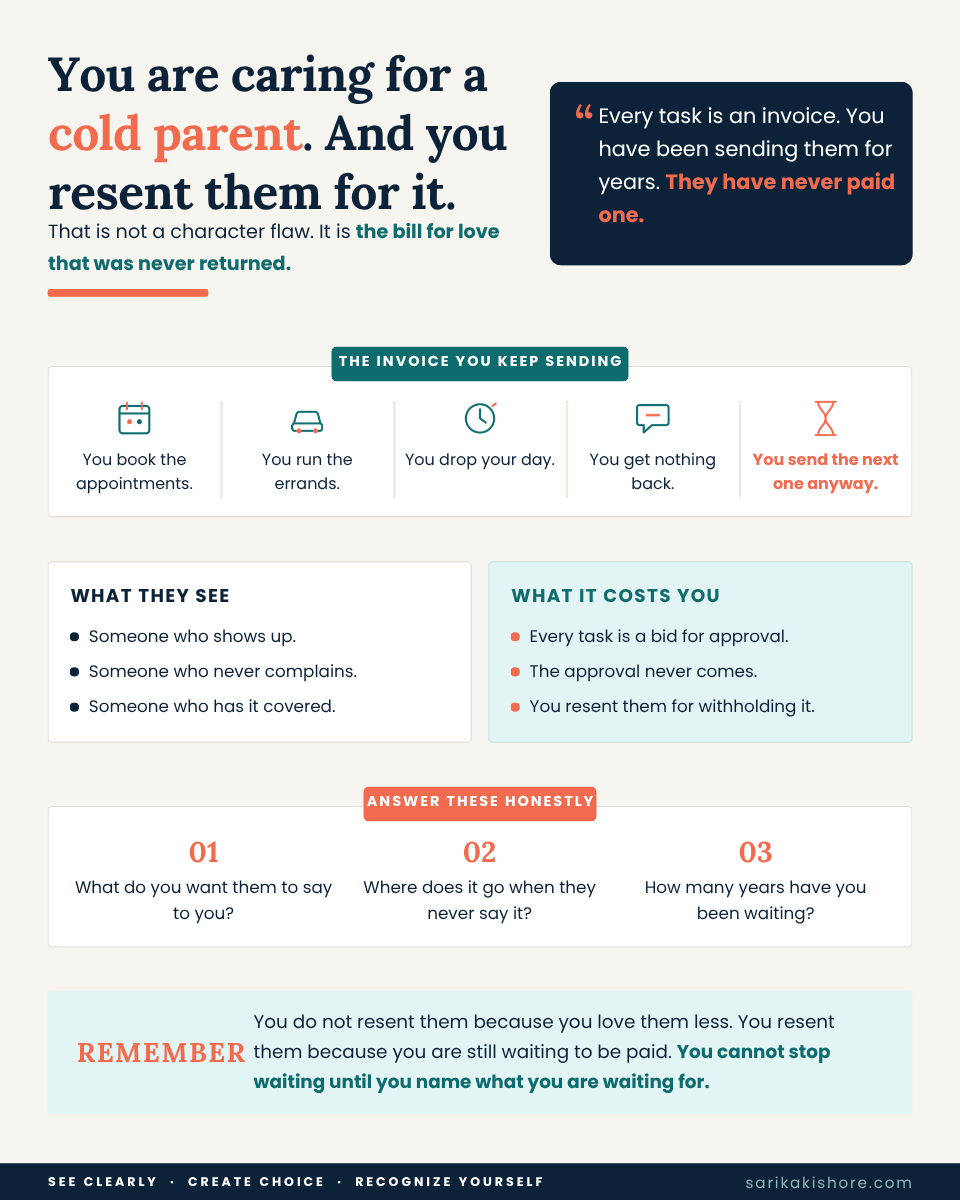
When you are the one who handles everything, the care and the strain begin to blur into each other. You book the appointments. You move the calls. You sit in the waiting room answering email. And somewhere in there, helping them and getting yourself through the hour become the same clenched thing.
When did doing everything become the only proof you had that you were a good son or daughter?
For a long time Jeremy thought the fix was his father. Get him to acknowledge one thing. Get one thank you. Then the tightness would settle. It never came, and the waiting became a second job he never clocked out of.
There is a name for the state he drives in. Carrying Everyone. From inside it, he is holding his father’s needs, his father’s moods, and the version of himself his father might finally approve of, and he is holding all of it alone. Every silent car ride becomes one more test he is failing.
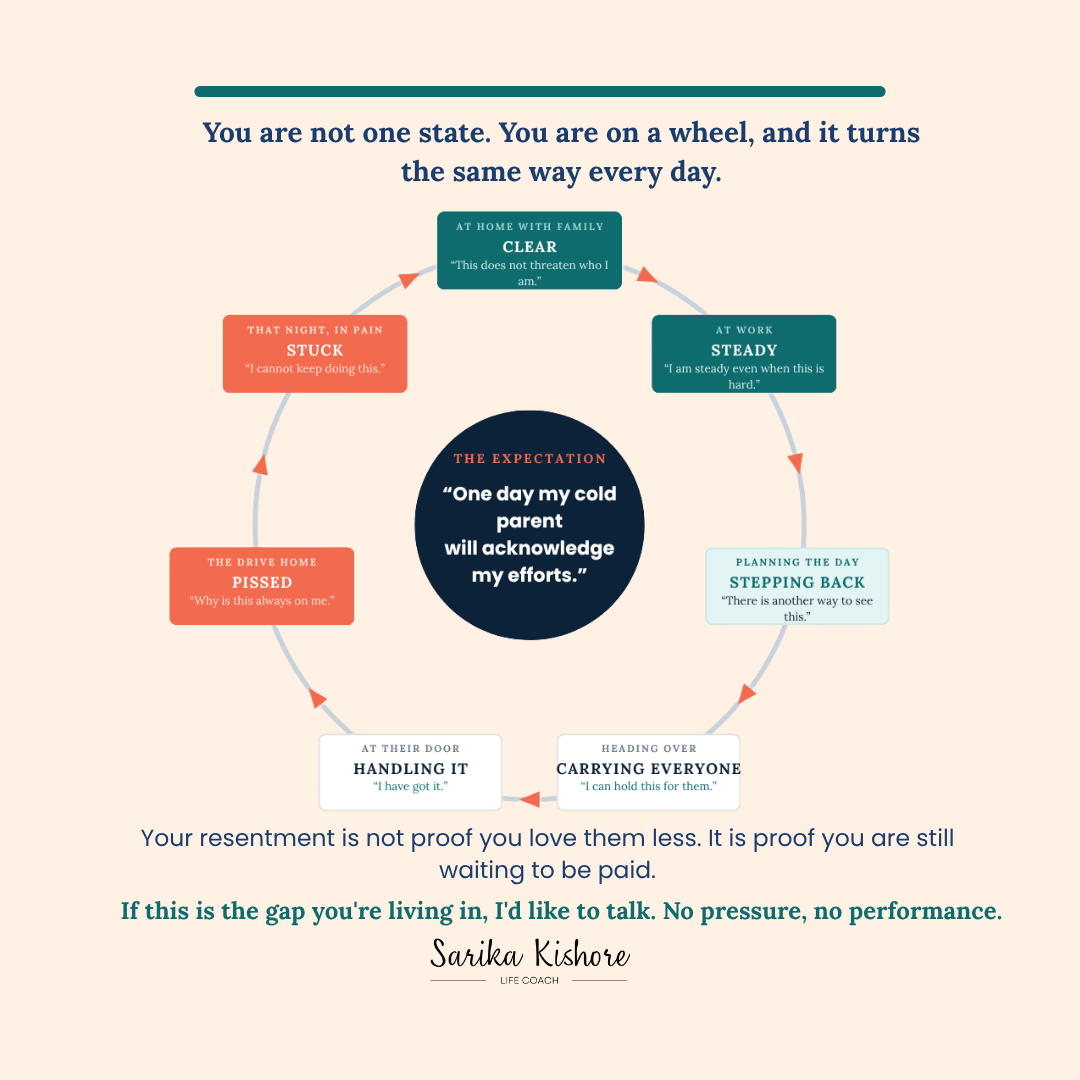
Here is the part that changes things. The drive does not have to cost that. Same road, same appointment, same difficult man. Made from steadier ground, where a parent’s approval is not the thing you are driving toward, the same care arrives at a completely different price. The action is rarely the problem. The load underneath it is.
That is where the real work starts. Not with a better strategy for managing your father. It starts with seeing the state you are actually operating from, finding the choice that was hidden inside it, and slowly remembering who you are underneath the role of the one who handles it.
But there is usually something older sitting underneath a back that locks up.
For Jeremy, it goes back to a boy whose report cards got a nod from behind the newspaper, if that. He learned early not to let the disappointment show, because showing it changed nothing and cost him something. So he stopped asking for anything and started achieving instead, quietly, hoping the work would say what he could not. It never did. He built two careers on that engine and became a grown man still turning in report cards to a father who would not look up.
What did you learn to stop showing, long before you ever became a caregiver?
When resentment shows up on those drives, it is easy to read it as proof you do not love them. It rarely is. Resentment is not a lack of love. It is a lack of support, the thing that builds when you keep giving from a place that never gets refilled.
Research suggests the cold house does not stay in the past. A large 2023 review of studies covering hundreds of thousands of adults found that people who lived through emotional abuse or neglect as children carry a meaningfully higher rate of chronic pain in adulthood. (European Journal of Psychotraumatology, 2023)
The body tends to keep what the child was told to swallow. There is a name for pain that works this way. Neuroplastic pain. It is real, physical pain that the brain and nervous system generate and keep firing, often in response to stress and emotion that never got resolved. This is not imagined, and it is not the dismissive kind of “all in your head.” It is a nervous system that decided, a long time ago, that certain feelings were not safe, and never got the message that the danger had passed.
If your back hurts, get it properly checked first. A real medical evaluation matters, and none of this replaces one. But when the scans keep coming back without a full explanation, or the pain flares on the drive to one particular house, there may be a part the imaging does not show.
There is also a way to work with it. Emotional awareness and expression therapy rests on a simple and uncomfortable idea. The emotions we never got to feel or say, the grief, the anger, the plain wish to be wanted, do not disappear when we swallow them. They get stored, and the body carries the bill. The work is to feel what got buried, to put it into words somewhere safe, and to let it move instead of sit.
Research suggests this is more than a figure of speech. Work by Mark Lumley and Howard Schubiner describes how emotion tied to early adversity that was never processed can change the brain pathways that handle both feeling and pain, and how facing those emotions directly can reduce the pain itself. (Current Rheumatology Reports, 2019)
And it holds up for the people least likely to try it. In a 2024 trial of older veterans with long-standing pain, most of them men, this emotion-focused approach reduced pain more than standard cognitive behavioral therapy. About 63 percent of them reached a clinically significant drop in pain, compared with 17 percent in the standard group. (JAMA Network Open, 2024)
A room full of older men who had spent decades not talking about any of this, and the talking outperformed the coping skills.
Here is what most people miss. You do not have to say any of it to your parent. Jeremy’s father is ninety-four. He is not going to look up now, and waiting for him to is exactly what keeps the load in place. The expressing happens somewhere safe, on your terms. The child who learned to go quiet finally gets to make some noise, somewhere the noise is allowed. This is part of how I work with clients, and it is why I trained in this approach.
The capable adult who built a whole life is not the child still waiting at the kitchen table to be noticed. That is the part worth coming back to. You can care deeply without erasing yourself in the process.
When did you last set the load down long enough to feel what was underneath it?
If you recognize some version of Jeremy in yourself, you are not being dramatic and you are not weak. A body that holds what it was never allowed to say is doing exactly what it was trained to do. What was learned that early can still be worked with now.
You do not need your father to change. You do not need your life to go quiet first. You need less of the load running silently underneath everything, and somewhere to set down what you have been carrying alone. This is the work I do with busy professionals caring for a difficult parent. We see the pattern clearly, we find the choices hidden inside it, and we rebuild the person underneath the role.
If this is landing, I would like to talk. This is not a sales call. It is a 30-minute conversation about what this has been costing you, and whether this work is the right fit. No pressure. No performance. Just a clear look at what has been happening.
Which State Are You In Right Now?
This post named a few of the states a caregiver moves through. Carrying Everyone. Stepping Back. Steady. There are seven of them, and you are never locked into one. They are not ranks, and none of them is the wrong one to be in. They are just information about where you are giving from today.
The short tool below shows you the whole set and helps you place where you are right now. It takes about a minute. Read it as a map of where you are driving from, not a grade on who you are. Every state is a doorway rather than a trap, and seeing the one you are in is the first move toward having a choice about it.
Frequently Asked Questions
How do you deal with a difficult elderly parent when nothing you do is ever enough?
When should you walk away from caring for elderly parents?
What is emotional awareness and expression therapy?
Is it normal to resent an abusive elderly parent you are still caring for?
Can emotional stress really cause physical pain like a bad back?
Key Takeaways
Doing more than anyone else and still feeling it is never enough is often not about your effort. It can be the residue of a child who learned that a parent’s moods were theirs to manage.
Resentment toward a parent who hurt you is not a lack of love. It is usually a signal that you have been giving from a place that never gets refilled, often to someone who cannot refill it.
Persistent pain deserves a real medical evaluation first. When the imaging does not fully explain it, unresolved emotion held in the body can be part of the picture, and that pain is real, not imagined.
You do not need a difficult parent to finally acknowledge you before you can set the load down. The person you have spent your life trying to convince may never be convinced, and your steadiness does not have to depend on them.
The same act of care can cost you almost everything or almost nothing, depending on the internal state you do it from. The action is rarely the problem. The load running underneath it is.